
The appliance repair market in the US continues to grow. According to Yelp data cited by the Wall Street Journal, demand for appliance repair services increased by 58% compared to 2022. Where do you get leads? Effective promotion of an appliance repair business in the US is directly tied to the quantity and quality of inquiries. In this article, we’ll break down all channels — free and paid — with real cost and conversion numbers.
This guide is for: owners of appliance repair companies in the US and Canada. All data and recommendations are taken from official sources, supplemented by our own experience in appliance repair lead generation across multiple states.
How Much Does an Appliance Repair Lead Cost — Real Numbers
Among the vast amount of information online about the real cost of an appliance repair lead, it’s extremely difficult to find objective and honest data. And there’s a reason for that. Here’s what every appliance repair business owner in the US and Canada must understand:
This means the cost of a lead in Chicago will never equal the cost in Seattle or Tampa Bay. In Sarasota, you might expect an average of $30 per lead (and that’s realistic), but in Houston, you’ll need to double that — or more, depending on the season. And that brings us to the second critical point:
Factor in seasonality for your region. For example, in the southern US, the season runs from late July (early August) through March (early April). During peak season, lead cost is several times cheaper than during the low-demand period.
Some sources, like LeadHelpline, identify the following pattern in lead conversion rates (https://leadhelpline.com/industries/appliance-repair-leads/) by lead type — which essentially maps to the channel of acquisition:
Lead Conversion Rates for Appliance Repair by Type
| Type | How It Works | Conversion |
|---|---|---|
| Exclusive live call | The call is instantly redirected to you alone | 40–60% |
| Callback lead | You receive the client’s number and call back | 30–45% |
| Exclusive web form | A form submission comes only to you | 25–40% |
| Shared web lead | The submission goes to 3–5 contractors | 10–20% |
Lead Types — Detailed Breakdown:
- Exclusive live call — the client calls from an ad or Google. Their call is redirected in real time to one contractor only. No one else receives this call. Example channels: Google Local Ads, Google Ads, SEO Local Pack.
- Callback lead — the client leaves their phone number on a provider’s site or form. The provider sends you the number. You call back. Example: Thumbtack or HomeAdvisor — the person fills out a form “need washer repair,” enters their phone. You get a notification with the number and problem description.
- Exclusive web form — the client fills out a form on your site (or a provider’s site). The submission goes only to you. But the client doesn’t call — they expect you to reach out. Example channels: Google Ads, SEO organic, SEO Local Pack.
- Shared web lead — the client fills out a form, and it goes to multiple contractors simultaneously (3–5 companies). Example: someone goes to Angi (formerly Angie’s List), writes “need refrigerator repair in Chicago.” Angi sends this submission to you, competitor #1, competitor #2, and competitor #3. All four call the same client. Whoever gets through first and offers the best price wins the job.
This table is informative, but in my view it doesn’t fully capture the quality differences between leads from various channels. Below, I’ll break down each channel and give my own assessment based on experience promoting appliance repair businesses across the US.
Free Lead Generation Channels
If you own an appliance repair business in the US, study this section carefully. What I’m about to share isn’t published anywhere else — it’s the truth from our own experience promoting appliance repair companies across different states, cities, and service areas.
No matter how you develop your business, you won’t reach a sustainable income level if your only source is purchased leads. During peak season, they might keep the business alive — but in the off-season, it’s a disaster. Lead costs can reach $90–$120 per lead (not per client — per lead!). That makes the business practically unprofitable. Make it a rule to develop two core channels:
- Google Business Profile (Google Maps)
- SEO — organic website traffic
Google Business Profile (Google Maps)
This channel is your GBP listing that appears in local search results for queries like appliance repair near me.
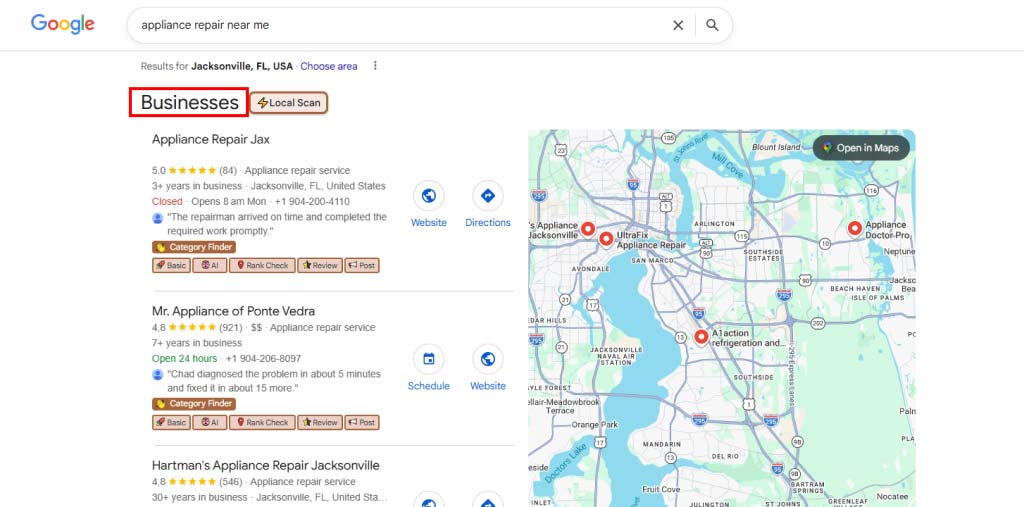
The key feature of this channel: you can get a lead from a client who never visited your website. They can convert (call or text) directly from the search results or from your company profile on Google Maps. The quality of these leads is the highest among all possible channels in this niche. I’d call this the #1 source.
For effective GBP promotion you need:
- A registered listing on Google Maps with a physical address
- A website
SEO — Organic Website Traffic
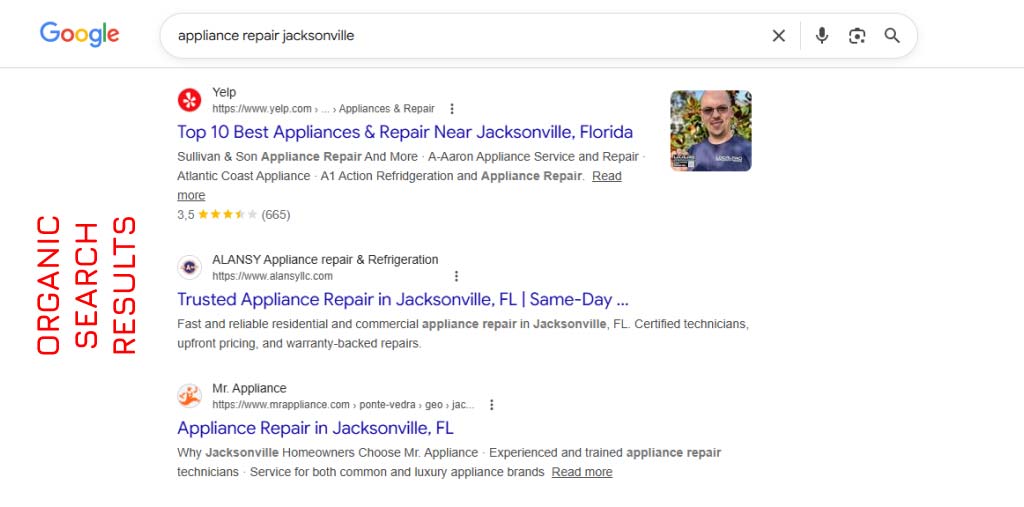
No matter how complex SEO may seem to most business owners in the US, I personally rank this channel #2 for lead quantity and quality. Most leads it generates are form submissions from your website — there will be 3–4 times more of those than phone calls. And even though you’ll usually need to call back, these leads are very high quality. From practice: business owners who handle leads responsibly convert 80%+ of form submissions into clients.
You’ll need to develop your website. For this, you need a qualified SEO specialist with experience in appliance repair promotion in the US.
При этом, важно понимать, что сайты в этой тематике могут сильно отличаться по своей структуре. Это обусловлена разной степенью поискового спроса в регионах. Это правда. Поэтому, то, что хорошо работает во Чикаго, может не очень хорошо работать во Хьюстоне.
It’s important to understand that websites in this niche can differ significantly in structure — driven by varying levels of search demand across regions. What works well in Chicago may not work in Houston.
I have a detailed guide on what an appliance repair website should look like. Each location has its own specifics that must be accounted for.
Reviews as a Lead Generator
Reviews don’t generate leads directly. No, no, and no again. Reviews are an important signal to the search engine about the quality and volume of your work. They participate in lead generation, absolutely — but not directly. They affect the visibility of your profile on Google Maps and its coverage zone. Two important points:
- It’s not the quantity of reviews that matters most, but the consistency of receiving them. Want to grow? Make sure reviews come in regularly — not many, but systematically.
- Average rating matters. If you could get away with 4.5 before, the current top performers now have an average of 4.8 or higher.
This effectively forces you to monitor your own reputation. Because even one or two low ratings can significantly lower your profile’s average rating if you have fewer than 100 reviews. And, consequently, affect the visibility of your listing.
Partnerships with HVAC, Plumbing, Remodeling Companies
This could be interesting, but I haven’t personally encountered or heard of such collaborations working at scale. Perhaps it’s worth exploring, but this channel will never be the primary one — because you have no control over it. You become dependent on others. Still, partnerships can be a nice supplement to your main free lead generation system.
Paid Lead Generation Channels
Paid channels are just as necessary as free ones. You can’t limit yourself to a single traffic source. The more sources you use, the higher the probability of increasing your promotion effectiveness. Among all paid channels, Google advertising for appliance repair is #1.
Google Ads (PPC)
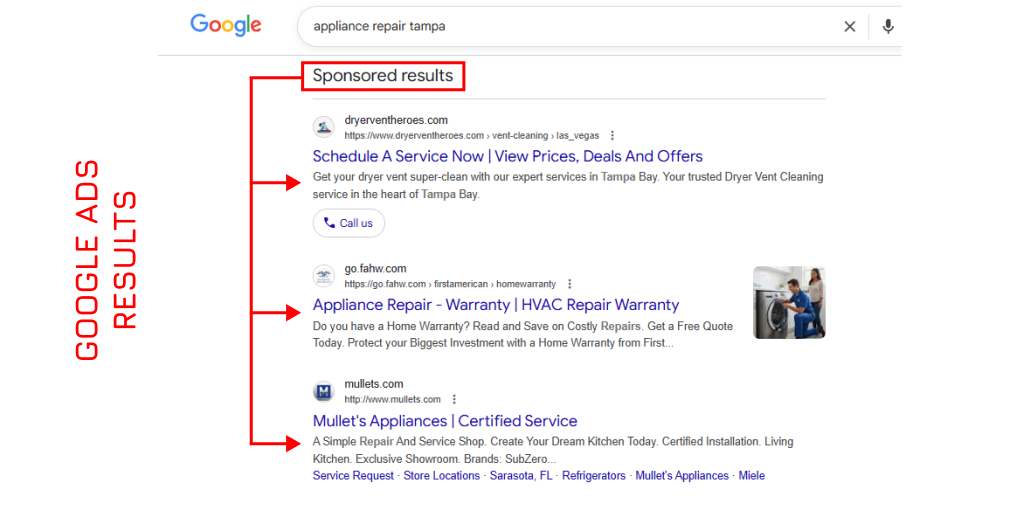
Google Ads (PPC). Google Ads in skilled hands is a powerful tool. But you need to understand what works for promoting appliance repair in the US and what doesn’t.
PPC advertising (pay-per-click) — you create a campaign, select keywords, set up targeting (location, time), write ads, and launch. The user searches, sees your ad, clicks, and lands on your website. Google charges you for the click.
Here’s the thing: everything described above, in 90% of locations in the US and Canada, won’t work! This is a mistake. You might even get some leads, but if you analyze the cost per client from this channel — you’ll realize it’s extremely expensive and inefficient.
So how should you use Google Ads to get affordable leads? The approach:
- We abandon promotion in the standard PPC zone. We don’t need expensive clicks.
- We must connect our Google Ads account to our GBP listing.
- We must get the system to advertise exclusively our GBP listing. Yes, this may reduce reach and traffic — but there’s a purpose: the quality and cost of interactions will be acceptable. The user can call directly from the paid local pack, visit the profile and call from there, or go from the profile to the website and submit a form.
I’ve managed to get leads in Florida at ~$9 each. All were high quality — mostly calls, less often form submissions. Ratio: 5 to 1. The target was a lead cost under $30 — that was the maximum the business could sustain. Client acquisition cost came out to ~$50–$60.
Here’s the plan:
- We’re opting out of advertising in the Google PPC search results. We don’t need expensive clicks.
- We must link our Google Ads account to our Google Business Profile listing.
- Our goal is to get the system to promote only our listing. Yes, this may reduce reach and traffic, but there’s a clear benefit: the quality of the leads and their cost will be much more reasonable. At the same time, users can call directly from the paid Local Pack without visiting the website, open the profile and call from there, or go from the profile to the website and submit a form. From experience, this strategy makes sense and can deliver strong results.
I was able to generate leads in Florida at around ~$9 per lead. All of these leads were high-quality—mostly phone calls, and less often website form submissions, with about a 5:1 ratio. At the same time, the target cost per lead was no more than $30—that was the maximum the business was comfortable with. The cost per acquired customer ended up being around ~$50–$60.
Drawbacks: At the start and during off-season, there won’t be many leads. But they won’t be expensive — the cost will be acceptable for the business.
Google Local Service Ads
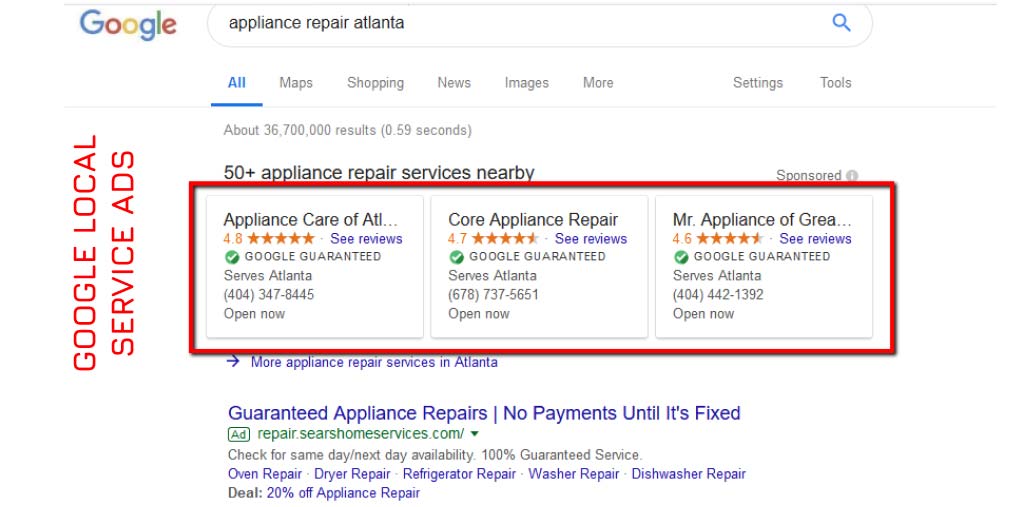
I intentionally separated this from Google Ads because, despite being technically part of Google’s ad ecosystem, it’s a completely different channel for the business owner — one that doesn’t require deep expertise to set up.
How it works
After registration and document verification, you specify your coverage area, list your services, and set your weekly budget. You can also set a maximum lead price. That’s it — no further configuration needed. Google then delivers leads as calls or form submissions. If the lead is low quality or bot-generated, you won’t be charged.
Advantages: Very simple to use. Provides high-quality leads. Conversion rate: 50%+ from lead to client.
Drawbacks: At the $30 target lead cost, volume will be limited — especially off-season, when the service may stop generating leads at that price. In practice, lead costs sometimes reach $90+ in this channel.
Pay-Per-Call Services
Many work with or know services like ResultCalls, 99Calls, ServiceDirect.
All I can say: many of my clients complain about lead quality from these providers. Though it can work. Cost: $20–100 per call, depending on location and season.
Pros: No risk of budget waste.
Cons: No control over quality.
Aggregators — Angi, HomeAdvisor, Thumbtack
Among these three, appliance repair business owners in the US overwhelmingly prefer Thumbtack.
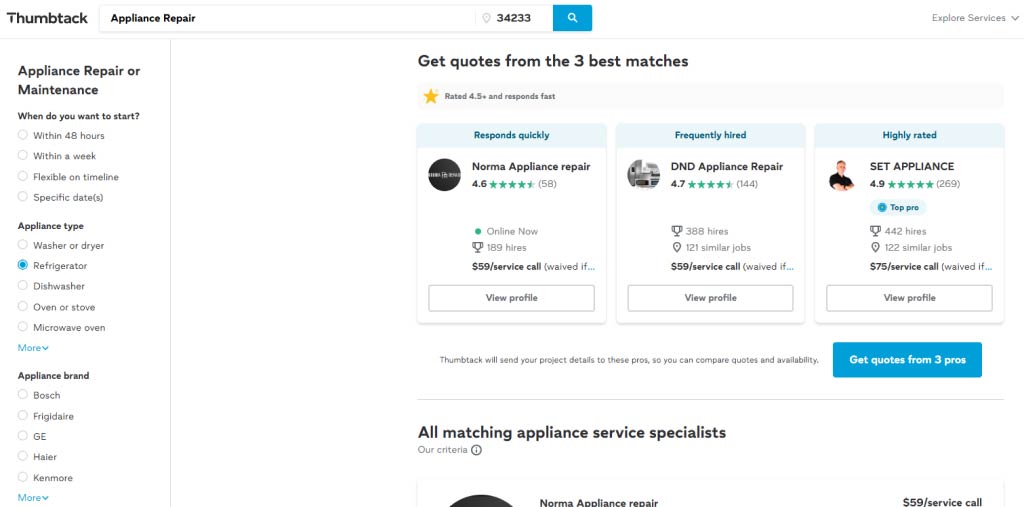
I often hear from owners: “I work with Thumbtack.” These are usually small businesses with 1–2 technicians, often without websites or Google Maps listings. But Thumbtack allows them to get leads — and most importantly, in my view, it gives them the opportunity to collect reviews. This matters enormously if the business plans to grow — for example, to build a website later. These reviews are real, high quality, and Google knows about them.
Payment models: Per lead, per subscription. Cost: $10–50 per lead.
Pros: Easy setup and management.
Cons: Lead quality. Clients often complain about low-margin inquiries. Plus — shared leads, low conversion, price wars.
Regarding Angi and HomeAdvisor — I can’t comment. None of my clients have used them.
Yelp Ads
Appliance repair Yelp advertising is the paid promotion of your Yelp profile.
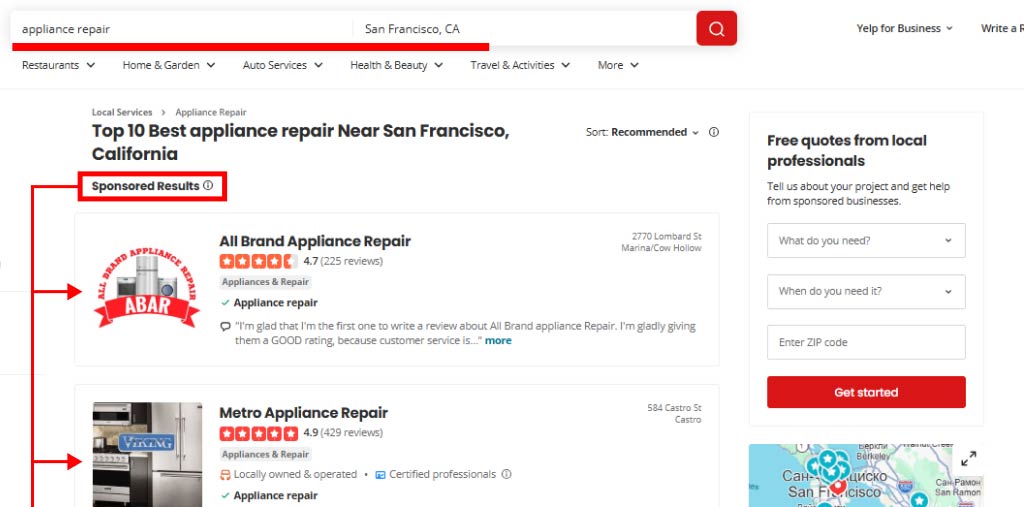
Can it work? Yes. I worked with a company in Illinois where over 50% of leads came from Yelp. But this channel has the same issue as other paid ones — effectiveness depends on location and season. Important Yelp-specific considerations:
- Getting Yelp reviews is difficult
- Clients sometimes leverage the fact that negative Yelp reviews can’t easily be disputed or removed — using this to pressure technicians into lowering prices
However, there have been cases where my clients, on a free Yelp plan without paying for ads, received leads from this channel — completely free. That’s the approach I support. The paid subscription for appliance repair can be recouped, but making a profit during off-season is unlikely. A free account with occasional free leads is an excellent supplement to your core channels.
Which Leads Convert Best
From everything above, my ranking of channels should be clear. Here’s the summary — my personal rating based on experience:
Channel Quality Ranking for Appliance Repair in the US and Canada
| Channel | Rank |
|---|---|
| Google Business Profile (Google Maps) — Local SEO | 1 |
| SEO — organic website traffic | 2 |
| Google Local Service Ads (Google Guarantee) | 3 |
| Google Ads | 4 |
| Thumbtack | 5 |
| Yelp | 6 |
| ResultCalls, 99Calls, ServiceDirect, etc. | 7 |
| Partnerships with HVAC, plumbing, remodeling companies | 8 |
How Many Leads Does Your Business Need — Calculation
The required number of leads definitely depends on the size of the company. A small business will have very different numbers compared to a large one, and it’s not always easy to calculate precisely. However, based on my experience working with appliance repair business owners, I can estimate lead volume depending on the number of technicians. The calculation is simple: each technician needs about five leads per day. Let’s assume an average lead-to-customer conversion rate of ~50%.
Formula: Target revenue ÷ average job ticket = required jobs. Required jobs ÷ conversion rate (50%) = required leads. Required leads × cost per lead = marketing budget.
Now, let’s present the results in a table:
Required Lead Volume by Company Size
| Technicians | Leads/month | Booked jobs/month |
|---|---|---|
| 2 | 300 | 150 |
| 3 | 450 | 225 |
| 4 | 500 | 250 |
| 5 | 650 | 325 |
| 6 | 800 | 400 |
| 7 | 950 | 475 |
Now you can easily estimate potential revenue based on your average margin in your area.
Mistakes We See at Appliance Repair Companies
Mistakes fall into two categories:
- Business mistakes — related to management, operations, and how the repair business is run
- Communication mistakes — everything related to ineffective promotion
About the first type, I’ll only say: some are fixable, some aren’t. It depends on the owner — their desire, understanding, vision, and, often, intelligence.
About the second type, here’s my ranking:
- Over-relying on paid channels at the expense of developing core platforms: website and Google Maps
- Having websites that can’t be promoted (most companies have sites, but promoting them is impossible — they need to be rebuilt to enable growth)
- Working with too many SEO specialists of questionable quality (resulting in a patchwork site — one person builds something, the next one builds on a broken foundation, and so on). The owner suffers, and the business becomes unpromotable.
- Using large quantities of low-quality backlinks, often on the advice of incompetent SEOs who don’t want to work with semantics, structure, or content. The result is a disaster — often unrecoverable.
- Buying fake reviews. Another frequent problem. Google has learned to track the authenticity of reviews.
- Wasting money on PPC that doesn’t deliver a profitable lead.
- Lack of quality content and unwillingness to produce it.
These aren’t all the mistakes I could list, but they’re the main reasons that, in my opinion, prevent appliance repair businesses from growing and getting the inquiries they need.
As always, I urge you: develop your brand, think about your clients, create useful content, and build a strong appliance repair business — in the US or Canada, doesn’t matter.
FAQ

My specialty is promoting service-based websites. I have solid expertise and a strong portfolio of SEO and Google Maps (local SEO) case studies across a wide range of industries, primarily in Home Services. Here, I share my case studies and insights. I’d really appreciate your comments and feedback!