
Most SEO agencies in the appliance repair niche, when handling promotion of an appliance repair business in the US, sell the client an idea: “create 20+ brand pages — and traffic will come.” They give seemingly solid justification: look at the search volume for these queries. There’s plenty to fight for! But is it actually true? Before you add brand pages to your appliance repair website, check the SERP first.
| Query | Volume/month |
|---|---|
| whirlpool washer repair | 110,000 |
| samsung washer repair | 90,500 |
| samsung fridge repair | 60,500 |
| samsung tv repair | 60,500 |
| lg washer repair | 49,500 |
| whirlpool dishwasher repair | 49,500 |
Why “samsung washer repair” Is NOT Your Query
This justification doesn’t survive the first SERP check. Nobody actually does this verification. SEO agencies mislead business owners — or simply copy what they see on successful competitor sites without understanding the other, more important factors at play. For those who want a quick answer:
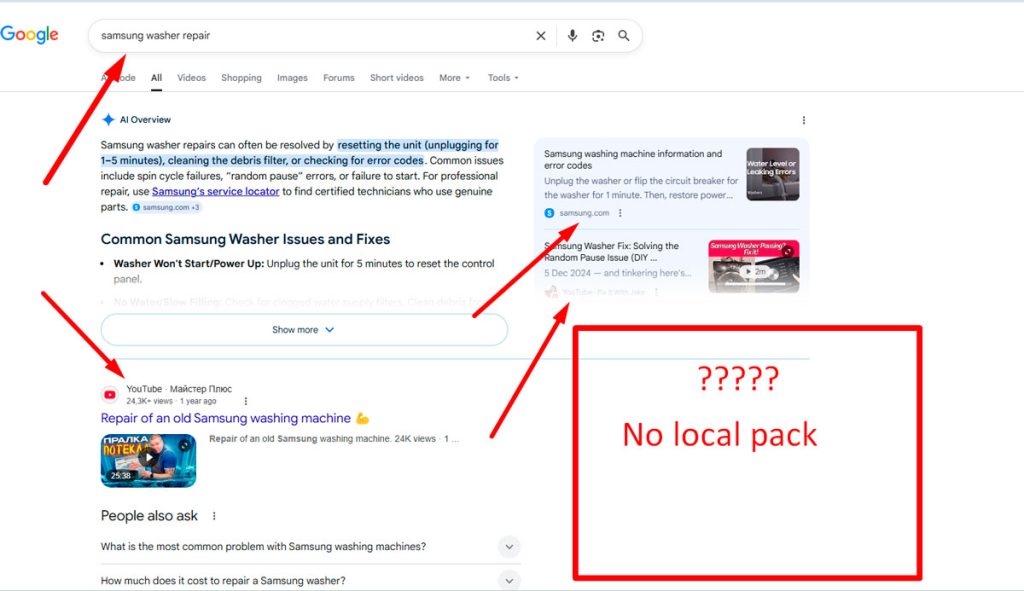
Let’s simply search for any brand keyword. Take “samsung washer repair” as an example. What do we see in the SERP? The SERP for “samsung washer repair” looks like this: YouTube, Angi, Yelp, Thumbtack, Samsung.com, Sears, Mr.Appliance (a franchise with hundreds of locations and massive backlink authority). A local business from a single city doesn’t appear — because this is a non-local query without a geo-modifier. Google gives it to aggregators with Ahrefs DR 80+. Need any more explanation to understand that small, medium, and even large city-level companies simply don’t make the cut? Appliance repair is a local business, and that’s exactly where the focus should be.
Why Brand Pages Can Actually Hurt Your Business
We established above that the focus for local appliance repair promotion should be on locality. This means our primary keyword must be: appliance repair + geo. For example, “appliance repair chicago” or “appliance repair seattle.” This page must be the strongest on our site. For companies operating in one city — regardless of size — a flat silo structure is the most effective approach.
Flat Silo Structure for an Appliance Repair Website
Before showing the structure variants, let me segment the page types for a local appliance repair website:
- Homepage — the main traffic source (and the entry point from the Local Pack funnel). Primary keyword: appliance repair + geo.
- Service pages — not for traffic! Remember this. Service pages for local repair won’t generate many leads. Reason: check the SERP. For most service queries, the results show homepages optimized for “appliance repair,” not service-specific pages. But service pages are needed to satisfy Google’s requirement for local businesses — having individual Services in the navigation is a mandatory element of local SEO, including GBP.
- Location pages — these ARE for traffic. Location pages can generate traffic and leads. But don’t rush to create a bunch of them — I’ll explain why below.
Variant 1: Basic Structure
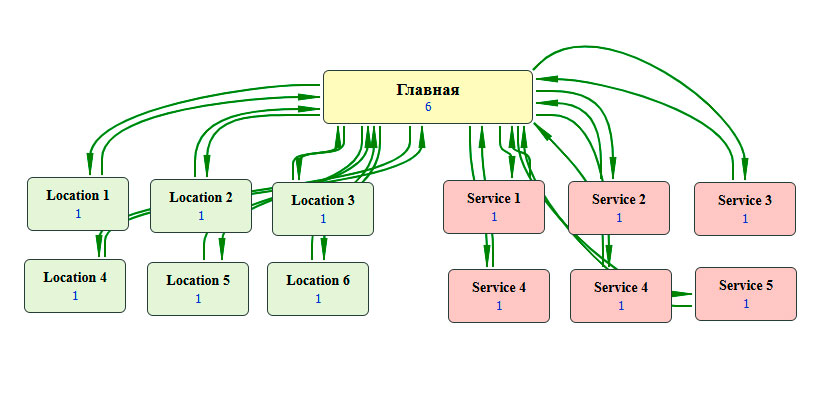
The structure looks like this:
The structure looks like this:
- Homepage has the highest weight through mutual interlinking — exactly what we need
- Service pages (marked red) are present in the structure, but we understand that actively promoting them is ineffective and pointless in most cases
- Six location pages are also mutually interlinked with the homepage — they can be traffic-generating
Everything looks clear and solid. But what happens to the structure if we decide not only to have these pages, but also to run a blog to support and promote the main traffic-driving page? Let’s take a look.
Variant 2: Structure with Blog
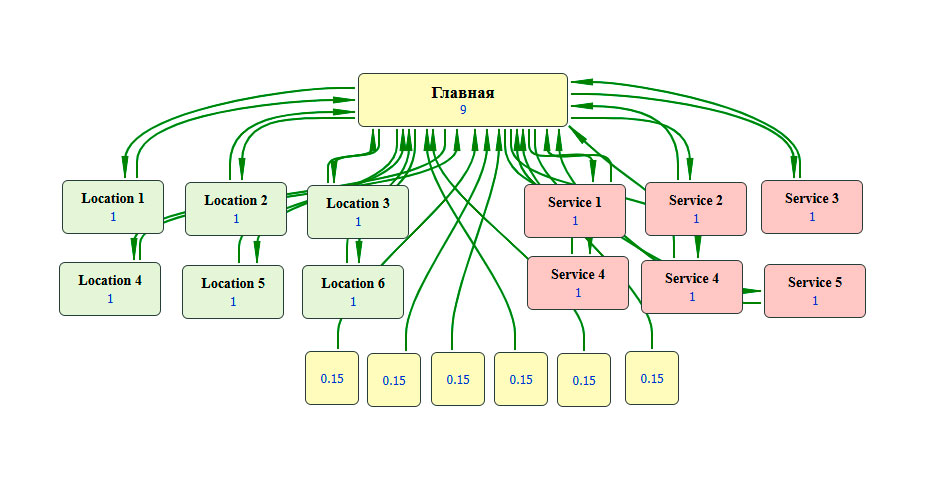
When we add 6 blog pages interlinked with the homepage:
- The six blog pages increased the homepage’s weight by a third
- The weight of location and service pages didn’t change
Excellent — we’ll start growing in local search, the number of geo-relevant internal links from blog posts to the homepage will increase, and the GBP listing will also start growing in the local pack. That’s exactly what we need!!!
Now let’s add brand pages to our structure—but there’s one important thing we need to consider:
If we link from the homepage to a location page, we’re signaling to the system that the primary ranking keyword for “repair” is better represented on a more content-rich page—the location page. And vice versa: if we link from the location page back to the homepage using the main keyword, the system will understand this, and the cannibalization issue will be resolved.
But how do we handle this with brand pages? Their content, aside from the heading, can’t really be unique—we don’t write blog content for individual brands, right?
Let’s say we add brand pages to the navigation. The problem is, these aren’t key pages. Still, they will inevitably “drain” authority from the homepage, which is something we definitely want to avoid.
As a result, a more logical approach is to link to them from service pages. That makes sense, since brands are tied to specific services (for example, Samsung makes refrigerators and washing machines, but not gas stoves):
Variant 3: Structure with Brand Pages Linked from Services
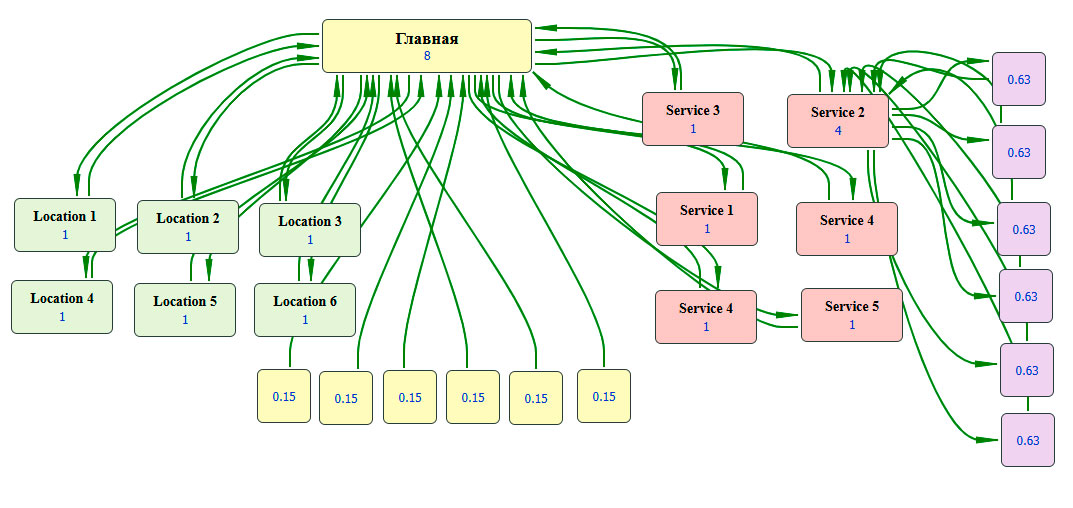
What we see:
brand pages receive links from only one service page. Look at the homepage weight — it decreased. If I link from another service page to brands, it decreases even more. In this scheme, we’re pumping service pages — which are completely useless to us — and reducing the homepage weight, which is absolutely not allowed. The move: service → brand pessimizes the homepage.
For a local company, this interlinking approach is unacceptable. If we want to rank in the Local Pack and in local organic search, we must focus on the homepage. With this structure, its weight doesn’t just drop — it drops proportionally to the number of brands that service pages link to. Catastrophe.
Alright, let’s imagine we’re a large company working with a wide range of brands. Even though we understand that the most popular brand pages are basically doomed—they won’t generate traffic due to the nature of the SERP—let’s try to estimate what would happen if we still introduced them as a thematic block on the homepage:
Variant 4: Brand Pages Linked from Homepage
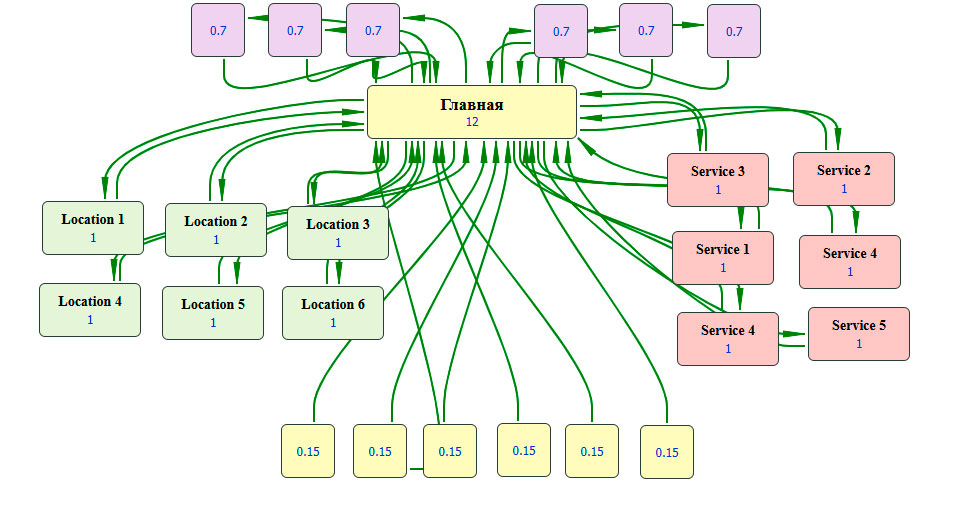
Whoa, you might say — the homepage just got way stronger. Yeah, but hold your horses.
We screwed up a bunch of things and completely ignored cannibalization. And with this kind of setup, it’s pretty much guaranteed to happen.
Okay, fine — let’s make one more assumption: suppose we magically fix all those problems somehow.
But our real goal here is still to push the main traffic-driving page (the homepage), right?
So let’s try this: what if we add another 6 pages inside the Blog section.
Variant 5: Brand Pages + 12 Blog Pages
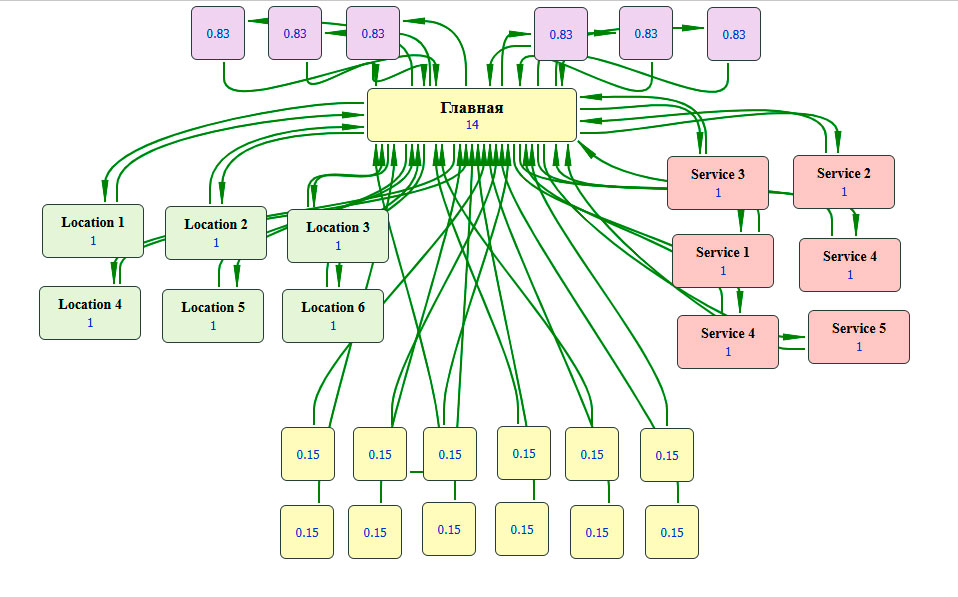
What we see:
the homepage grew, but notice — in Variant 2, publishing 6 blog pages gave the homepage a 33% PageRank increase. But as soon as we added just 6 brand pages (not 24, as many do — just six) plus another 6 blog pages, the homepage grew by barely over 12%. We’re putting in effort, but it’s producing minimal results. Weight is leaking from the homepage to brand pages that don’t generate traffic. They’re simply consuming our promotion efforts. They’re getting in the way.
Note that service pages and location pages technically do the same thing. But with important distinctions:
- Service pages, while not traffic-generating, are important pages — they’re a ranking signal for the GBP listing in the local pack. They’re necessary.
- Location pages can bring traffic and are traffic-generating, especially if you have GBP listings in those locations. They’ll deliver results if well optimized.
- Regarding location pages, you can also draw this conclusion: if there are too many of them — say twelve instead of six — they will also slow down the homepage growth rate, just like brand pages. In that case, you’ll be diluting geo-relevance. That’s exactly why you shouldn’t create too many — they’ll interfere with local promotion of the homepage. Create them with justification only.
The principle of local SEO strategy for appliance repair is not to disperse weight, but to concentrate it on the right pages.
Summary
- Brand pages in a flat structure hinder the homepage growth — which is devastating for local SEO.
- This absolutely does NOT mean you should ignore brand semantics. No, no, and no again! This semantics must be accounted for — but smartly, on the homepage itself.
This is the foundation of effective local SEO for appliance repair — focus weight on pages that actually generate leads.
This gives you multiple advantages:
- You expand the semantic layer of the homepage — which can positively impact rankings in both the local pack and local organic results
- You eliminate the cannibalization problem — it simply won’t exist, giving an additional boost to the homepage
- Your site structure becomes highly manageable for promotion: you run a blog, link properly, and get growth
FAQ

My specialty is promoting service-based websites. I have solid expertise and a strong portfolio of SEO and Google Maps (local SEO) case studies across a wide range of industries, primarily in Home Services. Here, I share my case studies and insights. I’d really appreciate your comments and feedback!