
Among the vast number of appliance repair websites in the US and Canada, If you study the best appliance repair websites in the US, you’ll notice a clear pattern: they all have, who do nothing but buy leads. If you analyze this pattern, you’ll see that successful brands have high-quality sites: they maintain them, regularly add content, and invest in structure. So what should an appliance repair website look like to actually drive business results?
What You Need to Know
Before we get into the details of building a website for appliance repair services in the US, it’s important to note that this business is local. Any company in this niche is limited by its location — a city (or cities), and often, if the city is large — by specific service areas within it.
This gives us the basis for understanding what helps a website grow. And the first and most important factor is structure.
Structure
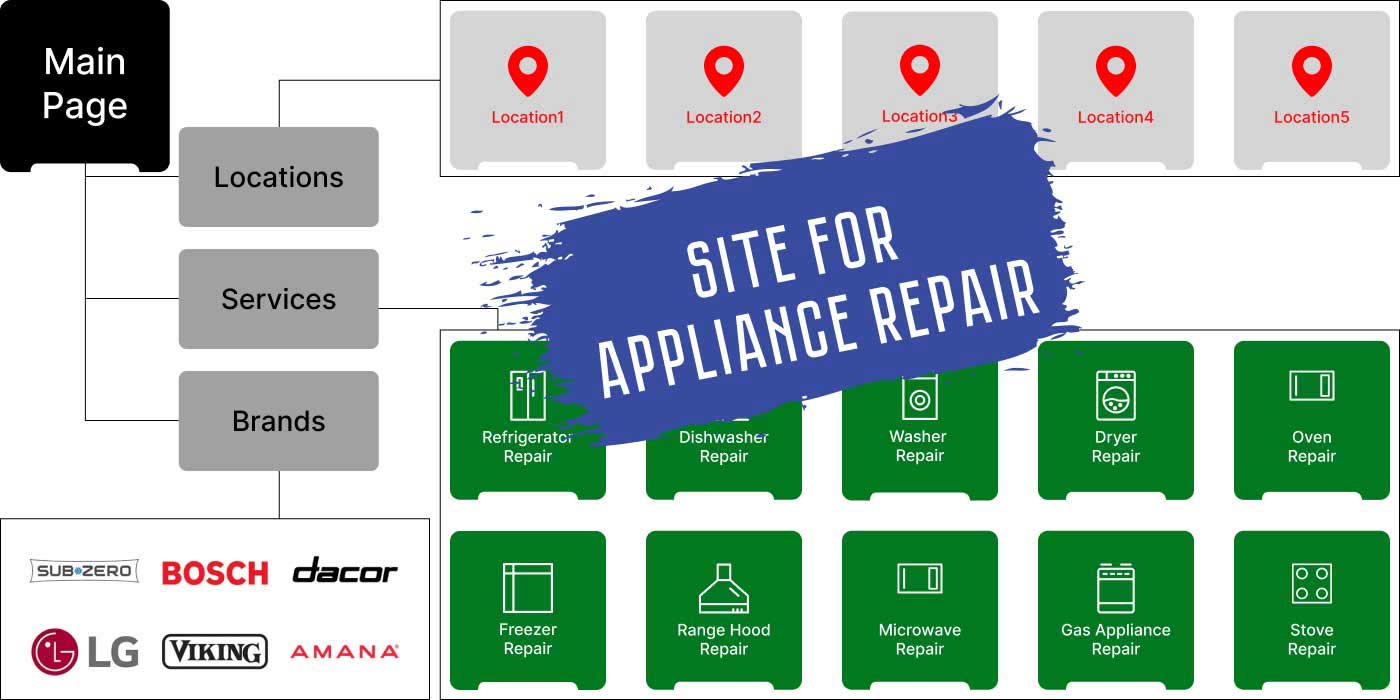
The core of a good structure is building topical hubs (blocks, sections). For an appliance repair website, we can identify the following types of pages and blocks:
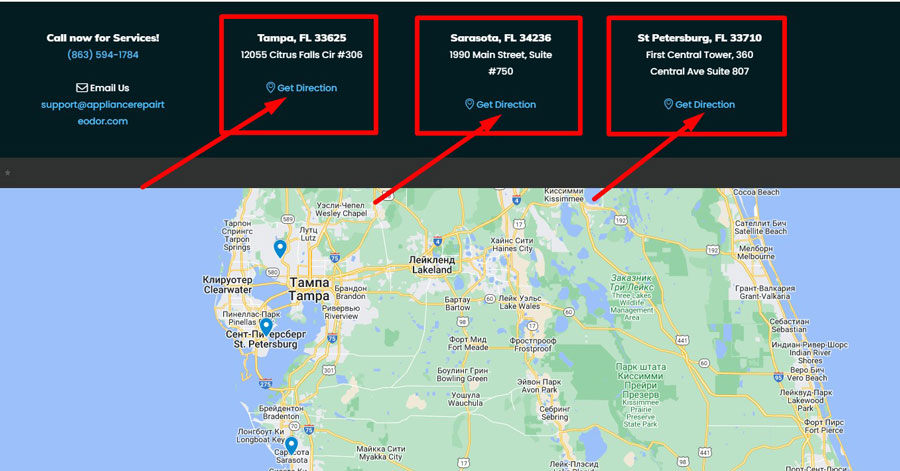
Beyond these essential elements, an appliance repair website should have a contact form block, and a map block showing directions to the office from specific service locations. The latter increases the company’s trust in a given area.
Now let’s address landing pages. Can a landing page be a viable option?
Landing Page for Appliance Repair — Will It Work?
By now, it should be clear that solving the problem of a quality website with a landing page will be extremely difficult. The reason: low topical relevance. Here’s what will prevent a landing page from delivering results:
From the above, it’s clear that no matter how well you optimize a landing page or how many backlinks you buy for it — it will always lose to a full website. Therefore:
Want leads for appliance repair in the US? Build a proper website.
Choosing a CMS
There are many opinions about the importance of CMS for service websites. In reality, this is not an important question at all. The CMS can be anything. What’s far more important is the quality of markup, clean document code, a proper mobile version, and site responsiveness. The recommended CMS is WordPress — simply because of its popularity, widespread adoption, and the abundance of plugins and components for development.
Many businesses start with an appliance repair website template — and that’s fine, as long as the template allows for proper markup and structure modifications.
Markup and Code Quality
Unlike the choice of CMS, the quality of markup has a very strong impact on website quality. Sites built on purchased or free themes often have poor markup quality, which is baked in by the template developers. This needs to be accounted for during development. Key points to note:
The quality of appliance repair website design — from markup to mobile responsiveness — is what separates sites that rank from those that don’t.
Localization
One of the key tasks of an appliance repair website is to clearly communicate to the search engine where exactly the services are provided. The reason: Google wants to deliver the most relevant answer to the user based on their location (personalized results using geodata). Google understands perfectly well why and who is searching for appliance repair. Its job is to give a user in Chicago the most location-relevant set of companies. Services from Florida or another state shouldn’t appear in those results. That’s why geo-relevance of content must be taken into account.
Here’s a tip: use the footer for proper local positioning. These are sitewide links and they can be very useful in this context. For example, listing your service locations in the footer with links to the corresponding location pages.
It’s also helpful to create your own map with markers for the company’s offices in different cities, if applicable.
Connecting the Website to GBP
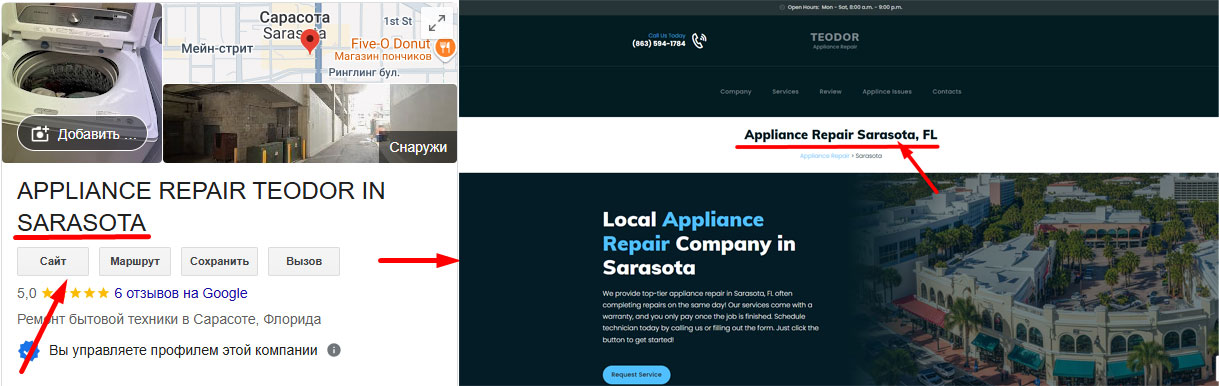
Connect the website to Google Business Profile correctly. If you have one GBP profile and serve one city — use the homepage as the main URL in your profile settings. If you have multiple profiles (in different cities or areas), then — based on the requirements described above — you should have dedicated location pages on your website. In that case, each GBP profile should link to the corresponding location page.
This is important because one of the paths to getting a client is converting them from the website page they land on after clicking through from the GBP profile or Google Maps. If you have one profile, there’s no problem. But if you have multiple profiles in different cities, you need to send users to their geo-relevant page. For example, don’t send a person from Chicago to the homepage of a company that operates across the entire state of Illinois. Send them to the Chicago location page. This way, you’ll increase conversions by delivering more relevant content to specific target groups.
Conclusion
It solves multiple tasks:
- For the business owner — it serves as the brand’s presentation
- For the user — it connects them with the service
- For the search engine — it provides the exact location of specific services
And finally, the key recommendation for building an appliance repair website:
To get clients through your website, you need to understand the principles of [how to promote an appliance repair business in the US](ССЫЛКА НА ХАБ РЕМОНТА EN).
FAQ

My specialty is promoting service-based websites. I have solid expertise and a strong portfolio of SEO and Google Maps (local SEO) case studies across a wide range of industries, primarily in Home Services. Here, I share my case studies and insights. I’d really appreciate your comments and feedback!