Что Нужно Знать для Продвижения в Google Maps?

What You Need to Know About Google Maps Promotion

Без Б » Blog » What You Need to Know About Google Maps Promotion

Google Maps SEO is becoming increasingly popular among local business owners in the US and Canada. This is no surprise — Google built local search specifically to deliver more useful results to people looking for services nearby. This guide covers every major local SEO ranking factor that determines your visibility in the local pack and local organic search.

Among the business types where this channel works best are all kinds of local services: restaurants, hair salons, clinics, repair services (appliances, electronics, phones, computers, HVAC), auto shops, and personal services (therapists, doctors, trainers, coaches). But beyond the diversity of niches, what makes this channel especially attractive for owners is its accessibility. To participate in local search results, all you need is to register your business on Google Maps and verify your Google Business Profile. That part is easy. But to achieve top positions and be visible across a significant area — everything needs to be optimized. That’s why we wrote this comprehensive local SEO guide, so you understand how marketing for home services and local promotion works and what it depends on.

What Affects GBP Visibility?

Google Business Profile setup
Customer Reviews
Website Quality
External links to pages on this site

It’s fair to say that your profile’s visibility in local search depends on its overall weight — the combined strength of these four factors.

It’s important to note that Google constantly refines its local ranking algorithm. Year after year, the list of local SEO ranking factors changes: new factors replace old ones, and their relative importance shifts. For example, in 2024 three additional signal groups were added to the four core components:

Additional GBP ranking signals

User behavior signals
Citation-related signals
Personalized recommendations (search history, location-based search)

How Ranking Factors Contribute to GBP Visibility

Before looking at the contribution of each factor group, it’s important to understand where traffic, calls, leads, and website visits come from. In local SEO, there are two main channels:

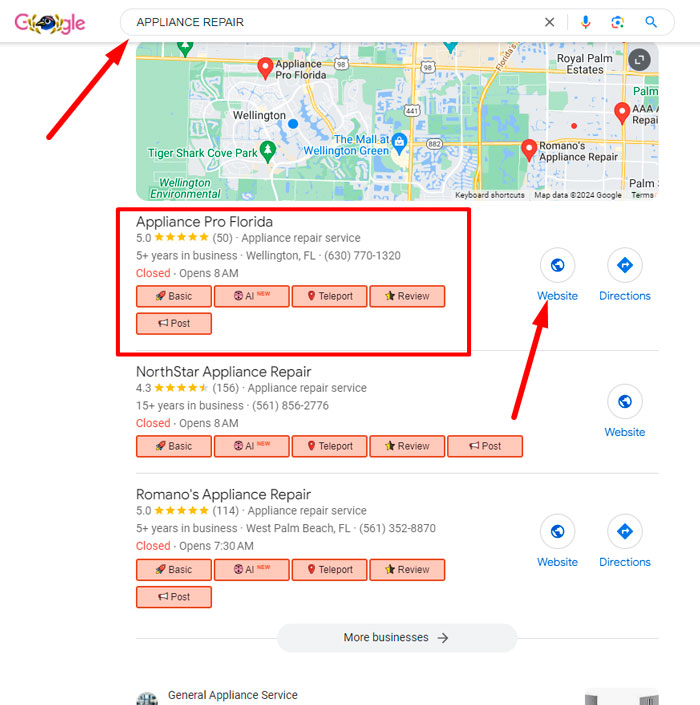
Local Pack — the map section with three listings that appears at the top of search results
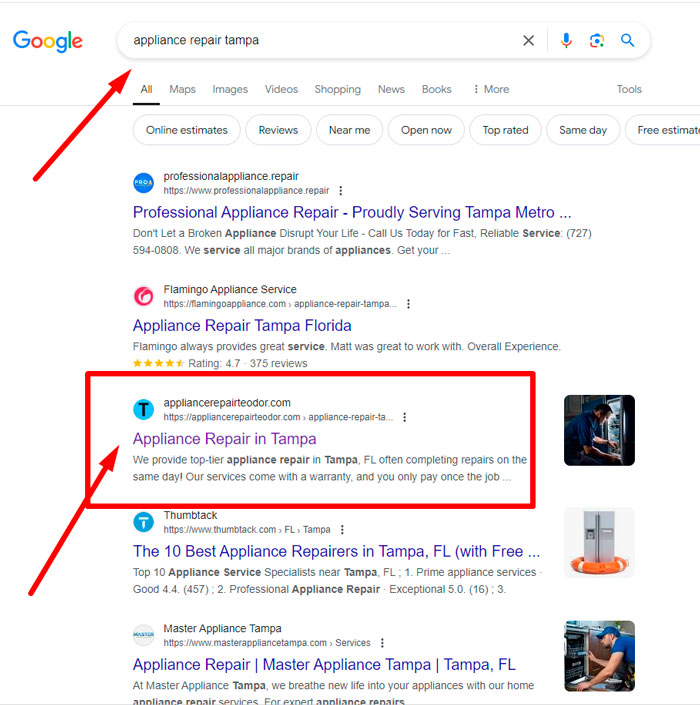
Local Organic Search — the standard blue-link results below the map

Example of output with the local pack

Выдача с локальным-пакетом

Example of organic search results

Органическая выдача

Factor Group Contribution

Local-SEO-Factors

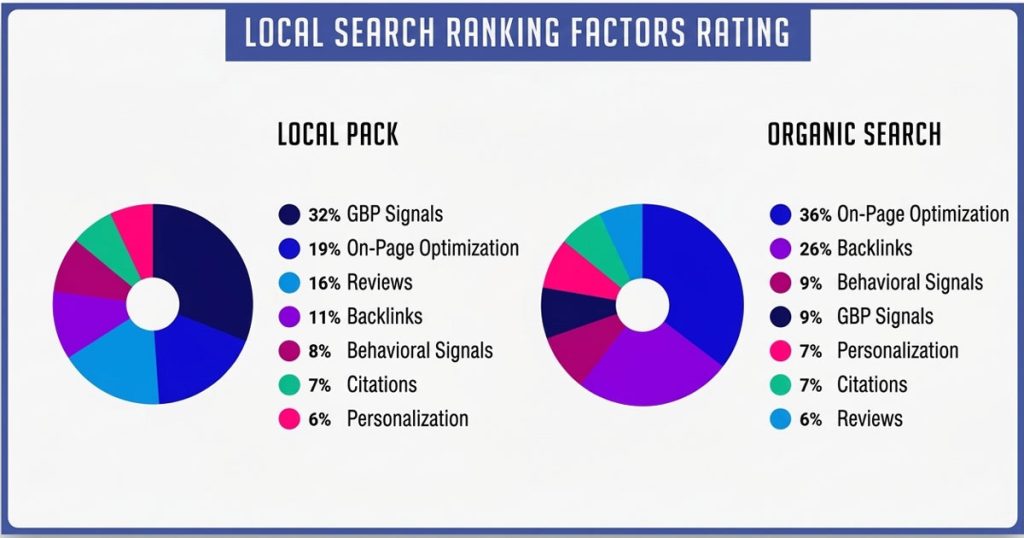
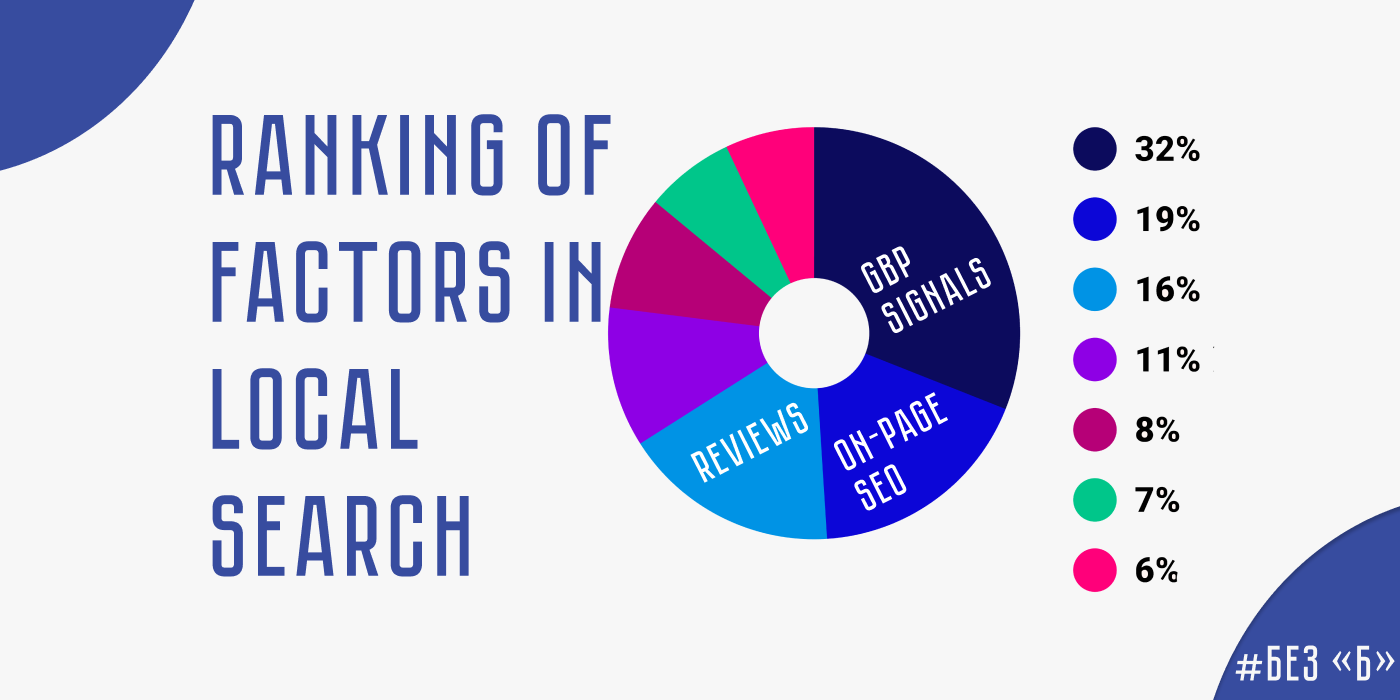
According to research by Darren Shaw and approximately 40 leading local SEO experts (published at whitespark.ca/local-search-ranking-factors), the contribution of each factor group to local pack ranking can be visualized as follows:

  • Personalization — ~7%
  • GBP Signals — ~32%
  • On-Page Signals — ~19%
  • Review Signals — ~16%
  • Link Signals — ~11%
  • Behavioral Signals — ~8%
  • Citation Signals — ~7%

Top 4 Factors for Google Maps Optimization

For Google Business Profile optimization and local pack ranking, focus on these four areas:

GBP profile optimization — categories, business name, completeness
On-page optimization of the landing page — title, headings, content, NAP
Reviews — quantity, quality, consistency, keywords
Backlinks — local relevance, industry relevance, authority

Top 4 Factors for Local Organic Search

The same four areas apply to ranking in local organic results. However, the relative importance shifts — the first two factors (on-page and links) account for over 60% of growth:

On-page optimization of the landing page
Backlinks to the website
Behavioral signals
GBP signals

What Determines Success in Local Business Promotion?

Combining factors for both the local pack and local organic search, success depends on five areas:

User behavioral signal improvement
On-page website optimization
Google Business Profile optimization
Link building (local SEO backlinks)
Review acquisition (Google reviews SEO)

Local Search Ranking Factors — GBP in the Local Pack

Darren Shaw’s research identified approximately 150 factors that influence GBP ranking in the local pack. Below are the top 30 most significant factors. The full list of 149 factors is available in the expandable table.

RankFactorScore
1Primary GBP category193
2Keywords in GBP business name181
3Proximity of address to the point of search176
4Physical address in the city of search143
5Removal of spam listings through spam fighting138
6High Google review ratings (e.g. 4–5 stars)134
7Additional GBP categories128
8Number of Google reviews (with text)117
9Verified GBP114
10Proximity of address to centroid114
11Keywords in GBP landing page title112
12Completeness of GBP profile105
13Steady stream of reviews over time (not spikes)102
14Dedicated page for each service101
15Keywords in GBP landing page headings (H1, H2)101
16Correct placement of map pin100
17Geo-relevance of domain content keywords100
18Internal links across the website99
19Inbound links from locally relevant domains98
20Review recency98
21Inbound links to GBP landing page URL from locally relevant domains97
22Citation consistency across major search engines (Google Maps, Bing, Apple Maps)97
23HTML NAP matches GBP NAP94
24Internal links to GBP landing page from other pages94
25Quality/authority of inbound links to domain92
26Quality/authority of inbound links to GBP landing page URL90
27Inbound links from topically relevant domains90
28GBP age90
29Keywords in anchor text of inbound links to GBP landing page89
30Branded search volume89

View all factors

RankFactorRating
31Thematic relevance of keywords (product/service) across the entire website88
32Number of backlinks to the domain from industry-related domains87
33The amount of high-quality content on the services pages86
34Keywords in Google reviews85
35Link to location-specific content on the GBP landing page82
36The extent to which a website focuses on a specific niche82
37Keywords in the anchor text of inbound links to the domain81
38Clicks on links from search results for relevant search terms / from geographically relevant locations79
39A positive tone in the review78
40Number of Google ratings (without text)78
41Mobile/responsive website78
42Company name in the text of inbound links to the GBP landing page URL78
43Correct category mappings in aggregators and first-level citation sources78
44Number of backlinks from locally relevant domains78
45Internal links from the GBP landing page to other pages on the website77
46The credibility of third-party websites that host reviews76
47Variety of inbound links to the GBP landing page URL76
48Number of engagement signals for GBP (scrolling through the list, clicking on photos, reading reviews, reading Q&As, clicking on posts, etc.)76
49Search Results Click-Through Rate (Overall)75
50Diversity of inbound links to the domain74
51Recognition in key industry sectors74
52Keywords in the headings throughout the website73
53Page load time73
54The amount of high-quality content across the entire website73
55Directions to Business Clicks73
56List of listings on key websites (Yellowpages, Yelp, D&B, CityGrid)72
57Clicks on the “Call” button71
58Keywords in headings (H1, H2, etc.) throughout the website71
59The website uses HTTPS by default71
60Number of backlinks to the domain71
61Consistency of links to data aggregators (Infogroup, Localeze, Foursquare/Factual)71
62Company name in the anchor text of inbound links to the domain70
63Variety of anchor text for the URL of the GBP landing page70
64Number of backlinks from industry-related domains70
65Number of positive Google reviews69
66Number of inbound links to the landing page URL69
67High ratings from reputable reviewers (e.g., Yelp Elite, Google Local Guides, etc.)68
68Variety of anchor text for the domain68
69Quality/authority of unstructured links (newspaper articles, blog posts, government websites, industry associations)68
70Keywords in the URL of the GBP page67
71Amount of content on the GBP page67
72Website domain authority67
73Store visits are tracked using location tracking in the Android mobile app or Google Maps66
74Quality/Authority of Structured Links65
75The presence of “website mentions” in local search results63
76Keywords in the domain name63
77Number of unstructured links (newspaper articles, blog posts)62
78Number of reviews on industry websites61
79Page load times for the entire website61
80URL authority of the GBP landing page61
81Availability of GBP services60
82Quality/Relevance of photos60
83Improvement/Completeness of citations60
84The presence of “Identifies as” attributes in GBP59
85The correct time is set to GBP59
86A variety of third-party websites that feature reviews59
87Number of third-party traditional reviews (e.g., Yelp, TripAdvisor, Yellow Pages, etc.)59
88A steady flow of links over time (rather than sporadic spikes)59
89Number of third-party unstructured reviews (e.g., blogs, newspapers, magazines)57
90Number of structured links (IYPs, data aggregators)56
91The company’s inclusion in lists of the best and similar companies compiled by experts55
92The inclusion of summary descriptions in local search results54
93Number of photos tagged by Google Vision AI based on keywords54
94High third-party ratings (e.g., 4–5)54
95Keywords in URLs throughout the website54
96The presence of “Provides” justifications in local search results53
97The number of reviews from trusted reviewers (e.g., Yelp Elite, Google Local Guides, etc.)52
98NAP in Schema/JSON-LD on the GBP landing page URL52
99Country code for GBP51
100Keywords in third-party reviews49
101Unprompted brand mentions49
102Keywords in the ALT attributes of images on the GBP landing page48
103Keywords in the text surrounding links to the GBP landing page47
104Citation order in other sources47
105Consistent content publishing over time (rather than sporadic bursts)45
106Total number of photos per GBP44
107The availability of attributes obtained through crowdsourcing44
108Keywords in the text surrounding links to the domain44
109Waiting time for GBP42
110Keywords for services in GBP41
111Whether owners have responded to most reviews40
112Number of services completed in Google reviews40
113The presence of outbound links to authoritative, thematically relevant websites40
114User attributes added to GBP39
115Built-in Google Map for location identification on the GBP landing page39
116Keywords in image ALT attributes throughout the website38
117Accredited by the BBB38
118Keywords in the meta description of the GBP landing page37
119Time spent on the GBP landing page37
120Keywords in GBP products36
121Store visits are tracked using third-party beacons or location-tracking technologies36
122Number of bookings through Google Booking partners36
123Availability of an XML sitemap34
124A detailed Google Q&A section featuring frequently asked questions from owners32
125Matching the Google Account domain with the GBP landing page domain31
126Keywords in the filenames of images on the GBP landing page30
127Setting up service areas in GBP29
128Number of messages via Google My Business Messages29
129The presence of Google’s attribution in local search results27
130Quantity of items per GBP27
131Keywords in meta descriptions throughout the website27
132Frequency of publications in GBP26
133Number of bookings made via the GBP booking feature26
134Presence of a destination URL25
135Keywords in GBP posts24
136Number of videos per GBP24
137Keywords in image filenames throughout the website24
138Reliable Photographer / Photography for Google Business View23
139Participation in AdWords, AdWords Express, Hotel Finder, or other paid Google products23
140Number of posts published in GBP22
141The GBP booking feature is enabled20
142Number of transactions identified through credit card partners20
143Number of questions asked on Google Q&A19
144The GBP messaging feature is enabled18
145Keywords in Google Q&A18
146Total amount of transactions identified through credit card partners16
147Keywords in owners’ responses to reviews12
148Keywords in the GBP description11
149Photos with geotags uploaded to GBP2

Local Organic Search Ranking Factors

RankFactorRating
1A separate page for each service163
2Internal links throughout the website149
3Quality/authority of inbound links to the domain148
4Geographic (city/district) relevance of the domain’s content keywords146
5Keywords in the GBP landing page title140
6Number of backlinks to the domain from locally relevant domains137
7Thematic relevance of keywords (product/service) across the entire website135
8The amount of high-quality content on the services pages134
9The amount of high-quality content across the entire website132
10Keywords in the anchor text of inbound links to the domain128
11Diversity of inbound links to the domain127
12Mobile/responsive website125
13Number of backlinks to the domain from industry-related domains124
14Keywords in the headings of GBP landing pages (H1, H2, etc.)119
15The extent to which a website focuses on a specific niche119
16Keywords in the headings throughout the website117
17Keywords in headings (H1, H2, etc.) throughout the website110
18The website uses HTTPS by default106
19Variety of anchor text depending on the domain106
20Physical address in the search city105
21Quality/authority of inbound links to the GBP landing page URL105
22Page load times for the entire website103
23Website domain authority102
24Keywords in the anchor text of inbound links to the GBP landing page URL101
25Number of backlinks to the domain101
26A steady flow of links over time (rather than sporadic spikes)101
27Internal links to the GBP landing page from other pages on the website99
28Number of backlinks to the landing page URL from industry-related domains98
29Variety of inbound links to the GBP landing page URL97
30Keywords in the domain name95

View all factors

RankFactorRating
31Clicks on links from search results for relevant search terms / from geographically relevant locations95
32Consistent content publishing over time (rather than sporadic bursts)94
33Search Results Click-Through Rate (Overall)94
34Landing page load time93
35Number of inbound links to the GBP landing page URL from locally relevant domains92
36Company name in the anchor text of inbound links to the domain91
37Internal links from the landing page to other pages on the website91
38Recognition in key industry sectors91
39Link to location-specific content on the GBP landing page88
40Number of search queries by company name88
41Keywords in URLs throughout the website86
42Keywords in the landing page URL85
43Variety of anchor text for the GBP landing page URL82
44The credibility of third-party websites that host reviews80
45Amount of content on the GBP landing page80
46Company name in the anchor text of inbound links to the GBP landing page URL80
47Proximity of the address to the search location (distance from the user to the business)77
48HTML NAP corresponds to GBP NAP75
49Quality/authority of unstructured links (newspaper articles, blog posts, government websites, industry associations)74
50Keywords in the text surrounding links to the domain73
51Availability of an XML sitemap72
52Number of third-party unstructured reviews (e.g., blogs, newspapers, magazines)70
53The presence of outbound links to authoritative, thematically relevant websites69
54Number of inbound links to the GBP landing page URL69
55The company’s inclusion in lists of the best and similar companies compiled by experts69
56Number of backlinks from locally relevant domains68
57A variety of third-party websites that feature reviews65
58The order of links in major search engines (Google Maps, Bing Maps, Apple Maps)65
59Number of backlinks from industry-related domains65
60URL authority of the GBP landing page63
61Number of unstructured links (newspaper articles, blog posts)63
62Keywords in image ALT attributes throughout the website58
63Unprompted brand mentions58
64NAP in Schema/JSON-LD on the GBP landing page URL57
65Quality/Authority of Structured Links57
66List of listings on key websites (Yellowpages, Yelp, D&B, CityGrid)55
67High Google star ratings (e.g., 4–5 stars)55
68Number of reviews on industry websites54
69Number of third-party traditional reviews (e.g., Yelp, TripAdvisor, Yellow Pages, etc.)52
70Ключевые слова в атрибутах ALT изображения на целевой странице GBP52
71Consistency of links to data aggregators (Infogroup, Localeze, Foursquare/Factual)52
72Keywords in the company name GBP50
73Keywords in the text surrounding links to the GBP landing page49
74Main category: GBP48
75Correct category mappings in aggregators and first-level citation sources47
76Number of structured links (IYPs, data aggregators)46
77High third-party ratings (e.g., 4–5)45
78Keywords in image filenames throughout the website45
79Improvements/Completeness of citations45
80Keywords in the filenames of images on the GBP landing page44
81Proximity of the address to the centroid43
82Keywords in third-party reviews42
83A positive tone in the review41
84Citation order in other sources41
85Keywords in the meta description of the GBP landing page38
86Accredited by the BBB38
87A steady stream of feedback over time (rather than sporadic bursts)37
88Number of Google reviews (with text)36
89Keywords in meta descriptions throughout the website36
90Time spent on the GBP landing page36
91High ratings from reputable reviewers (e.g., Yelp Elite, Google Local Guides, etc.)35
92Recency of reviews35
93Built-in Google Map for location identification on the GBP landing page35
94Quality/Relevance of photos33
95Keywords in Google reviews33
96Verified GBP32
97GBP fill rate31
98The presence of justifications for “website mentions” in local search results31
99Additional GBP categories30
100Number of photos tagged by Google Vision AI based on keywords29
101The number of reviews from trusted reviewers (e.g., Yelp Elite, Google Local Guides, etc.)27
102Age GBP24
103Participation in AdWords, AdWords Express, Hotel Finder, or other paid Google products22
104Number of engagement signals for GBP (scrolling through the list, clicking on photos, reading reviews, reading Q&As, clicking on posts, etc.)21
105Matching the Google Account domain with the GBP landing page domain21
106Clicks on the “Call” button21
107Waiting time for GBP21
108The presence of “Provides” justifications in local search results20
109Directions to Business Clicks20
110The inclusion of summary descriptions in local search results19
111Correct placement of a marker on the map19
112Number of positive Google reviews19
113Country code for GBP16
114Removing spam listings through anti-spam measures16
115Number of Google ratings (without text)16
116Total number of photos per GBP15
117Quantity of items per GBP15
118Number of services completed in Google reviews15
119Store visits are tracked using location tracking in the Android mobile app or Google Maps15
120Whether owners have responded to most reviews13
121Number of bookings through Google Booking partners13
122A detailed Google Q&A section featuring frequently asked questions from owners12
123The presence of Google’s attribution in local search results12
124The correct time is set to GBP12
125Frequency of publications in GBP11
126The availability of attributes obtained through crowdsourcing11
127Availability of GBP services11
128User attributes added to GBP11
129Store visits are tracked using third-party beacons or location-tracking technologies11
130Number of transactions identified through credit card partners11
131Setting up service areas in GBP10
132Keywords in owners' responses to reviews10
133Number of messages via Google My Business Messages9
134Keywords for services in GBP8
135Total amount of transactions identified through credit card partners8
136The GBP booking feature is enabled7
137Keywords in GBP posts7
138Presence of a destination URL7
139Reliable Photographer / Photography for Google Business View7
140Keywords in the GBP description6
141Keywords in GBP products6
142The presence of “Identifies as” attributes in GBP6
143Number of questions asked on Google Q&A6
144Number of videos per GBP6
145Number of bookings made via the GBP booking feature5
146The GBP messaging feature is enabled4
147Keywords in Google Q&A4
148Number of posts published in GBP3
149Photos with geotags uploaded to GBP1

Our Own Observations

Based on years of hands-on experience promoting local businesses in the US, here are the patterns we consistently observe:

Website quality is the multiplier. A strong, well-optimized website amplifies every other signal — GBP, reviews, links. Without it, even perfect GBP optimization hits a ceiling.

Reviews are a hygiene factor, not a growth driver. To maintain positions, you need roughly 1 review per week. To grow in competitive markets, 2–3 reviews per week are necessary. At that pace, reviews stop being a limiting factor.

Internal linking is underrated. Most local businesses treat their site as a brochure. But a properly interlinked blog feeding authority to the homepage can increase its PageRank by 30%+ — we’ve measured this across multiple clients.

Not all GBP listings are equal. Some listings acquire trust quickly and convert well. Others barely move. The difference often comes down to NAP consistency, category selection, and the quality of the linked website.

Top 5 Significant Changes in Google Maps Ranking

Over the past several years, the local ranking algorithm has evolved significantly. Here are the five most impactful shifts:

Website quality now matters more than ever. Google has been steadily increasing the weight of on-page signals for GBP ranking. A poorly built site now directly drags down your map listing.
Behavioral signals are a confirmed factor. Click-through rate from the local pack, direction requests, and call clicks all feed back into ranking. This means your GBP listing itself needs to convert.
Review velocity matters more than total count. A steady stream of 2–3 reviews per week outperforms a burst of 50 reviews followed by silence.
Citation importance has declined. While NAP consistency still matters, mass citation building has diminishing returns. Focus on quality citations from locally and topically relevant sources.
GBP spam fighting has become a ranking factor. Reporting fake competitors who stuff keywords in their business names can directly improve your own ranking.

Myths in GBP Promotion

Several persistent myths continue to waste business owners’ time and money:

Myth: Google Ads help your GBP ranking. Google Ads is a separate customer acquisition channel. It does not influence your organic local ranking. Don’t confuse paid and organic channels.
Myth: Posting frequency boosts your GBP. While the system used to respond to GBP posts, this no longer works as a ranking signal. Posts can be useful for engagement and conversions, but they won’t increase your profile’s trust or ranking.
Myth: Keywords in GBP description improve ranking. The description field ranks at #148 out of 149 factors in the Whitespark study — essentially zero impact. Fill it out for users, not for algorithms.
Myth: Geotagged photos boost ranking. Geotagged photos rank dead last (#149) in the factor list. Upload quality photos for users, but don’t waste time on geotag tools.

Conclusions

Local SEO Checklist — Quick Reference

Before you start optimizing, make sure you have these fundamentals covered:

  • GBP verified and fully completed (all fields, correct categories, services listed)
  • Primary category matches your main service keyword
  • Business name registered with the keyword (using a legitimate DBA/trade name)
  • NAP (Name, Address, Phone) consistent across Google, Bing, Apple Maps, Yelp, and data aggregators
  • Website homepage optimized for “service + city” keyword
  • Dedicated service pages in site navigation
  • Internal links from blog → homepage (with geo-relevant anchors)
  • Steady review acquisition: minimum 1/week to maintain, 2–3/week to grow
  • Quality backlinks from locally relevant domains
  • Mobile-friendly, fast-loading website with HTTPS

If you’re wondering how to rank higher on Google Maps, the answer is straightforward: invest in these four pillars consistently.

  1. Google is making Maps ranking increasingly dependent on website quality. This pushes business owners toward creating better web solutions focused on the end consumer. If your site is weak — your map listing will be weak.
  2. The five pillars of local SEO success are: on-page optimization, GBP optimization, link building, review acquisition, and behavioral signals. No single pillar works in isolation.
  3. For most local home service businesses, the most effective approach is a comprehensive home services marketing strategy that combines all five pillars with a focus on the homepage as the primary traffic-generating asset.
  4. Don’t chase factors that don’t matter. Focus your effort on the top 30 factors that actually move the needle, not on posts, geotagged photos, or GBP description keywords.

FAQ

How useful was this post?

Click on a star to rate it!

Average rating 5 / 5. Vote count: 1118

No votes so far! Be the first to rate this post.

Leave a Reply

Your email address will not be published. Required fields are marked *