
In 2026, reviews have become one of the strongest ranking factors for local businesses when promoting in Google Maps. From experience, business owners often underestimate their impact and, when faced with the difficulties of getting them regularly, lose positions in local search results and, as a consequence, the number of inquiries from potential customers.
In this article, we will go into detail about all possible ways of getting reviews and, based on our own experience, give recommendations on getting feedback.
How Many Reviews Does My Business Need?
There are various opinions about the number of reviews needed for a location’s growth in the local pack. In our opinion, for the growth of young companies in local search results, you should aim for 2-3 reviews per week. It is important to understand that the modern trend in working with customers is connected not so much with the quantity of reviews as with the dynamics of getting them. The system requires regular signals from your customers. This signal is critically important for growth and promotion in the local pack.
RECOMMENDATION: 2-3 reviews per week — the necessary minimum for GBP location growth.
5 Legitimate Ways to Get Reviews
There aren’t many honest, or “white hat,” methods of getting reviews. All of them are listed below. And it doesn’t really matter which one or which ones you use. What matters is what you get as a result of your actions.
1. A personal request right after completing the service.
You see that the customer is satisfied and smiling, thanking you. They are clearly pleased with the cleaning that was performed, or with the appliance repair. It is the perfect time to politely ask them for a review while they are at the peak of positive emotions.
RECOMMENDATION: At the time of payment, you can ask the customer to scan the QR code of the reviews page in GBP.
2. SMS message a few hours after the service is performed.
Address the customer by name, thank them for choosing the company, leave a link to the reviews page, and express gratitude in advance for the feedback. Also leave the employee’s name in the signature, not only the company name. Avoid automation: a personal message that contains both your name and the customer’s name increases the response rate by 25-30%.
3. Email
Email outreach works worse, the message may go unread or end up in spam. However, this method is still useful for part of the audience. As with SMS, follow the rules of personalization. Think about a subject line that could grab attention.
Tip: use the customer’s name in the subject line, write briefly, do not add banners and logos.
4. QR code on the invoice and on a magnet.
Order nice-looking magnets and put the inscription on them: «Thank you! Scan here to review us». The customer will see your magnet every day — the conversion may be spread out over time, but it is steady.
5. A phone call 2-3 days later.
Works well for expensive services such as kitchen remodeling, pool building, roofing, HVAC installation. The first part of the call is to check whether the customer is satisfied, whether everything is working, and whether something may need to be fixed. The second part of the conversation is asking them to leave a review. Usually, the conversion rate is high, around 30-40% of customers leave reviews after such a call.
Where to Get a Review Link
You can use several options.
1. A direct link takes the user straight to the review submission form, bypassing the business search. This eliminates 2-3 steps — and doubles the conversion rate.
Steps to follow:
- go to the Google Business Profile dashboard
- find the «Get more reviews» block
- copy the short URL in the format g.page/r/….
This link is permanent and can be used in SMS, email, and on invoices.
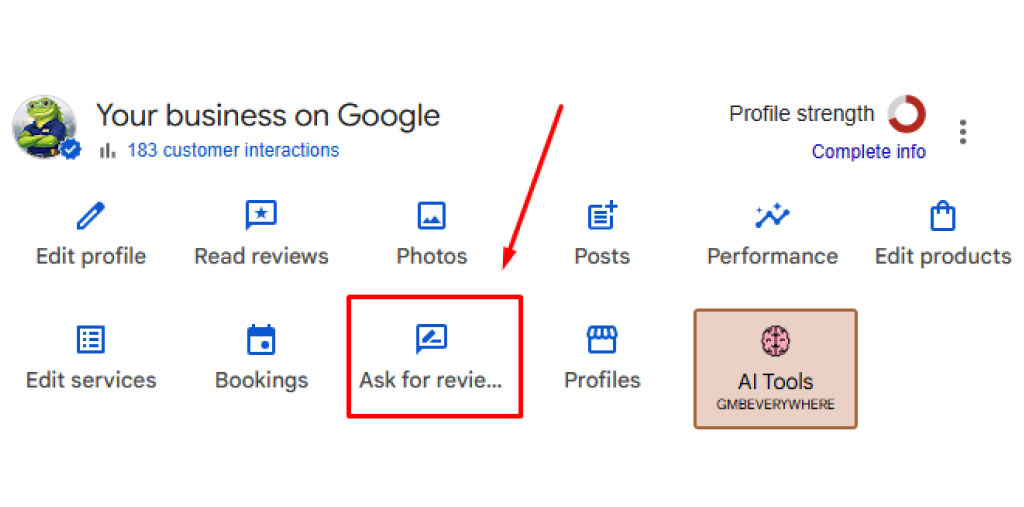
2. In the settings of your profile, you will also find the Ask for reviews block. There, in addition to the link, you will see a QR code that can be saved and shared with customers.
3. An alternative way is through the Place ID lookup tool on Google Developers, where you get the profile ID and build the link manually: https://search.google.com/local/writereview?placeid=YOUR_ID.
The necessary code has been added in this tool. You only need to enter the name of your profile and you will get your ID.
How to Respond to Reviews
A few recommendations that work:
- Respond to all reviews, both positive and negative.
- Respond as quickly as possible. It is best not to delay your reply by more than 24 hours. Your responses are not just a formality. They serve several purposes: 1) a way to build customer trust; 2) an additional signal for Google.
- Use keywords, geo terms, and your company name in your responses. For example, refrigerator repair Austin and then in the text, thanks for choosing the company [company name]. You can also ask the customer to mention in the review itself the service that they ordered.
- Don’t use the same keywords in reviews and responses too often. For example, to avoid this, the general key “appliance repair + location” can be written in different ways: appliance repair Austin, appliance repair in Austin, appliance repair Austin TX, Austin appliance repair, appliance repair Austin Texas.
- Don’t spam: don’t add keywords or branded elements (the company name) in every review and response.
- Try to add a variety of keywords for different services in your responses. For example, if it’s cleaning, then specifically what kind (regular cleaning, deep cleaning, upholstery cleaning).
- Use additional words in your keyword phrases. For example, best cleaning company in San Diego; professional carpet cleaning New York, affordable maid service Tampa.
- Reply to positive reviews briefly and try to personalize each response.
- Negative reviews require a more detailed response. Don’t make excuses and don’t argue, acknowledge the problem if it actually happened (it never happens that everything is perfect all the time). Offer a solution, for example a discount, a bonus, or a free repeat visit. You need to respond in such a way that users who will read the reviews and responses (and they most often start with the bad reviews) will understand that your company can be hired.
TOP 7 Violations Google Will Suspend a Profile For
Young entrepreneurs often look at what successful competitors do and copy them, not realizing that those competitors are operating with “gray hat methods.” And some intentionally resort to such methods. But it is worth remembering that what works for others can lead to penalties for you.
Here is what Google considers direct violations of its review policy in 2026:
- Buying reviews. Fiverr, Reddit, services offering “100 reviews for $300” — Google catches templated text, IP addresses, and behavioral patterns. The filtering algorithm became even stricter back in 2025.
- Paying customers. A discount for a review, a free service, a gift card — these are incentivized reviews. It is prohibited even in the form of “thanks for the review, here’s $5.” What is allowed: thanking customers without tying it to the fact of leaving a review.
- Review gating. Asking for reviews only from satisfied customers. It has been prohibited since 2018 — but many still do this and don’t understand why their profile is being filtered.
- Reviews from your own devices. Leaving a review for yourself from your home IP, from your team’s smartphones, from a single office Wi-Fi network. Google can easily detect this.
- Asking friends and family. If a person did not actually use the service — it’s a fake. Google checks connections through social graphs. However, there is one loophole here, which is described below.
- Mass templated reviews. 20 identical texts saying “Great service, highly recommend!” in a week — that’s a red flag for the review filter.
- Removing negative reviews using gray hat methods. Buying “review removal” services through third-party contractors — almost always a scam, and often leads to new problems with the profile.
Consequences of violations: review filter (reviews are hidden automatically), a warning in the dashboard, GBP suspension for 30-90 days, permanent suspension with loss of the entire history, automatic shutdown of LSA with the budget frozen.
Quality of Reviews — Which Ones Work Better?
For Google, not all reviews carry equal weight. Even among five-star ones. The algorithm evaluates not only the rating and text, but also the author, their behavior on Google services, geography, and the format of the review itself.
- The most valuable reviews come from real users, with profiles that have history and activity on Google services and a phone number attached. If they live in the same city where your business operates — that’s the ideal scenario: the principle of geo-relevance is met, and the algorithm sees the review as a signal from a local resident.
- On the opposite end — reviews from empty profiles: no photo, no history, with a location thousands of miles away from your business. They either get filtered automatically or are counted with minimal weight. That’s why the number of reviews on its own is not a reliable indicator — 50 reviews from real local profiles weigh more than 200 from anonymous accounts.
- Reviews from friends and family. I will note that this is not a “white hat” method, and is considered a violation of Google’s policy. But you can try to work around it. For example, you have an appliance repair business. Model the customer’s path. Ask a friend or family member to go to Google, enter the keyword by which your GBP profile shows up in the local pack, or your branded term. Then they need to actually call directly from your profile. After that, they can write a review in which they mention that they were given a phone consultation, and that they were satisfied with it. In the review, they can specify what appliance the question was about, and whether you advised them to repair it, buy a new one, or do the repair themselves.
AI-generation — the red flag of 2026
Google knows perfectly well when AI-generation is present in the text of reviews. Ask people to write in their own words. Even if a review is written by a local expert but is fully generated, that review is at best useless, and at worst, Google may penalize the profile for such reviews.
Completeness of a Review — the Hierarchy of Authority
Within a single category of reviews, their weight varies by format. The more complete a review is by these criteria, the higher its authority.
- Just stars, with no text — minimal weight.
- Stars + a short text.
- Stars + a detailed text mentioning the service and the area/city — helps with ranking on specific queries.
- Stars + text + a photo — high weight: the photo adds a visual signal.
- Stars + text + photo + keywords (the name of the service, the area/city, the technician’s name) — maximum weight. Google uses such reviews in search result snippets, highlighting matches with the user’s query.
Fake reviews and how to deal with them
Everyone is familiar with these situations:
- A customer you’ve never served leaves a one-star rating.
- An unscrupulous competitor leaves a negative review to ruin your rating.
- Or, most frustrating of all, a real customer writes a harsh review because of a simple misunderstanding that could have been resolved with a single phone call.
You can’t remove such a review on your own. Through Google — you can, but with difficulties. Google removes reviews after reviewing an appeal only when there are clear grounds: spam, conflict of interest, offensive language, false information, or irrelevant content. The appeal process starts by submitting a complaint through the Google Business Profile interface. Review usually takes from a few days to a couple of weeks. If Google denies the appeal — don’t be discouraged and don’t try to bypass the system using “gray hat” methods.
Conclusions
So, to sum up everything mentioned above, let’s highlight the most important points:
- Don’t rely on abstract benchmarks. Analyze your competitors in the local pack of your geo and track the dynamics of review acquisition weekly over the course of a month. This way you will understand how many reviews your competitors are getting and how many you need to get in order not to fall behind them.
- The baseline pace is 2-3 reviews per week. This is a signal that the business is up and running.
- Out of the five legitimate ways to get reviews, the one that works best is — a personal request right after payment. The other four methods: SMS, email, QR magnets, a phone call a few days later — reinforce the main channel rather than replace it.
- SMS and email without a CRM are a waste of effort. If you don’t have automation yet — focus on the personal request and QR codes. Connect SMS channels only once your CRM is up and running.
- Respond to every review within 24 hours. Use keywords and geo terms in your responses, vary the wording, and don’t spam with the same keywords.
- Not all 5-star reviews carry equal weight. A review from a real local user with a real Google profile is worth more than three reviews from anonymous accounts. A review with a photo and a mention of the service is worth more than a review without details. Aim for quality, not just quantity.
- AI-generated text is a red flag. Ask customers to write in their own words, even if it’s short and contains mistakes. Authentic text works better than perfectly polished writing.
- You can use gray hat methods of getting reviews, but remember that this can lead to your profile being suspended.

My specialty is promoting service-based websites. I have solid expertise and a strong portfolio of SEO and Google Maps (local SEO) case studies across a wide range of industries, primarily in Home Services. Here, I share my case studies and insights. I’d really appreciate your comments and feedback!