
Без Б »
We received a request to promote a cleaning company in Seattle. The company was just created, young, with no digital presence of its own. In addition, the GEO deserves a separate description. The city of Seattle has very high competition in cleaning (and not only in that). This region, unlike the South of the USA, is characterized by sky-high prices for paid search in this niche. Promoting standard cleaning services through paid search is therefore inefficient — it is very expensive. The only alternative is local SEO and Local Ads. We understood that a very thorny and difficult road awaited us in promoting this project: a new company, a zero-age domain, a brand-new location in Google Maps with no history. But we did something almost impossible, even though the collaboration lasted only 4 months (September–December). The client paused the work because they did not see strong results. And then, a month after the fallout — the fruits of our work started to pay off. In February — leads started coming in. Without our involvement. The fallout turned into a case study. Here is how we built it.
What We Had at the Start
So, I will highlight the following key initial data points:
- New domain (age: 0)
- No location in Google Maps
- No website
- Highly competitive area (approximately 500 cleaners in the search results, average domain age 8–10 years)
As we can see, the chances of getting a lead quickly were minimal. And yet we took the risk.
Website and Domain
Domain Selection
The thing is, our clients had a registered LLC name — Magiclean. It was decided to register an available domain based on that name and check it against the classifier for topical relevance. Several significant mistakes were made here:
The choice was made in favor of the domain magicleanseattle.com. At first glance, everything seems fine. We hit the niche (the word “clean”) and the geo (the word “seattle”). But in reality — that was not the case. Google associated the word “clean” with the first part — “magi”. What did that lead to? As it turned out in practice, we ended up in the cleaning products segment. We had to spend time trying to fix this problem. Some of it worked out, but time was lost.
Website Creation
I was surprised by how different the top-ranking resources in Seattle could be compared to Chicago, Tampa, and Detroit. The semantics differed significantly from what we had worked with before. But the website “framework” was similar:
- flat structure — no hubs
- five service pages
- strong development of the homepage with soft clustering (in this location, in this niche, that is the right approach)
- fourteen pages for nearby locations
- connection to the GBP location
Visuals — provided by the client. Design and development took six weeks.
Google Business Profile — Registration and Verification
The biggest problem when registering a GBP location is the address. Not only does it need to be located in an area where there is demand for your services, but it is also preferable for it to be a real address. For example, a rented house or a standalone property works perfectly for this if your focus is on home cleaning. But here was the problem — our clients did not have an address. They were living in a rented apartment (condo). Google is very reluctant to verify such addresses, so it was decided to rent an office at the time of verification. And here, a second mistake was made:
The client was evaluating the location from the standpoint of its “prestige”, expensiveness, and the affluence of the population. Forgetting about their own place within the niche. The result was what it was.
The location was verified on the second attempt, by escalating it to manual review. It was amusing to hear the Google representative (an Indian girl) insisting that we nail a plastic sign to the glass door with actual nails. Yes, that happens too.
Posting — 10 Publications to GBP and Directories
The basis for posting is topical articles. During posting to GBP — no issues arose. The main problem came from the manta service used for updating the company’s NAP. We connected the service correctly, but, as it turned out later, made a mistake:
Here is the issue: when setting up manta, you need to specify the category of your business. That would be fine, except that manta’s categories do not match GBP’s categories — they are different. When you link this service to your location, an update of the latter will inevitably occur and the category settings in GBP will be replaced with manta’s categories. This is a disaster for location promotion! This specific issue was probably what significantly dragged out the growth process and served as the trigger for the client deciding to leave.
The Client Left — December
At the end of December, the client made the decision not to continue the collaboration. We accepted that decision with understanding — indeed, we had received the first leads, but the expectations were higher. Meanwhile, we had fixed all the problems and mistakes in the promotion: the website was significantly revised, an additional service was added, the issues with the location name and categories were resolved. The work was paused in that state.
February — 45 Leads from the Website Without Our Involvement
The first positive signals came in January. When the work was already on pause. The website started generating leads. But the most interesting thing happened in February — leads were coming in every day. Here are the messages we received after forms were submitted:
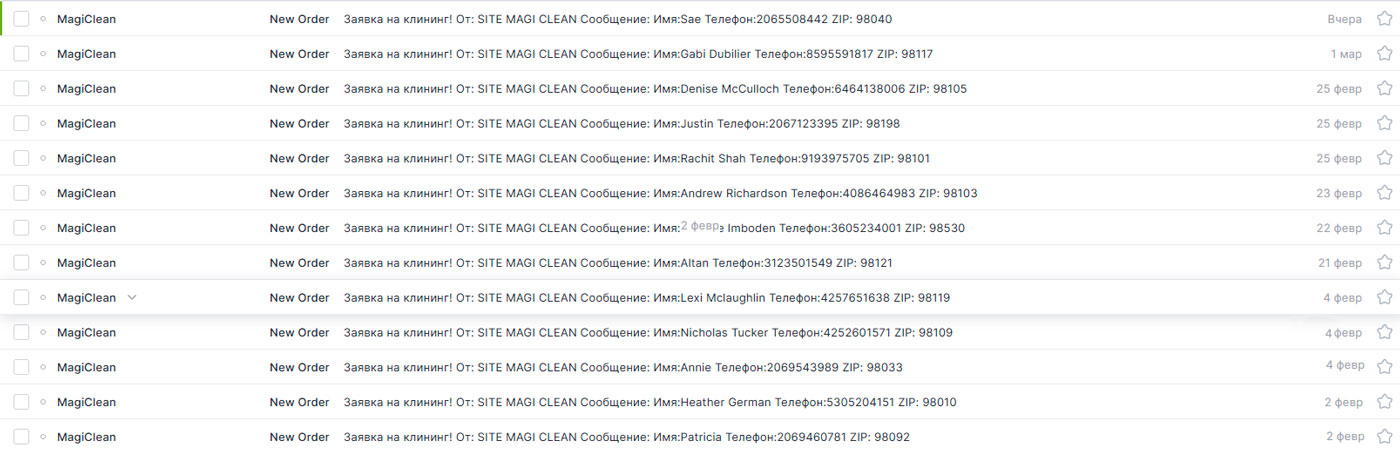
A total of 11 forms. We got curious — how many phone calls did the client receive from the website. The analytics were still there, and we looked at the data. And here is what came up:
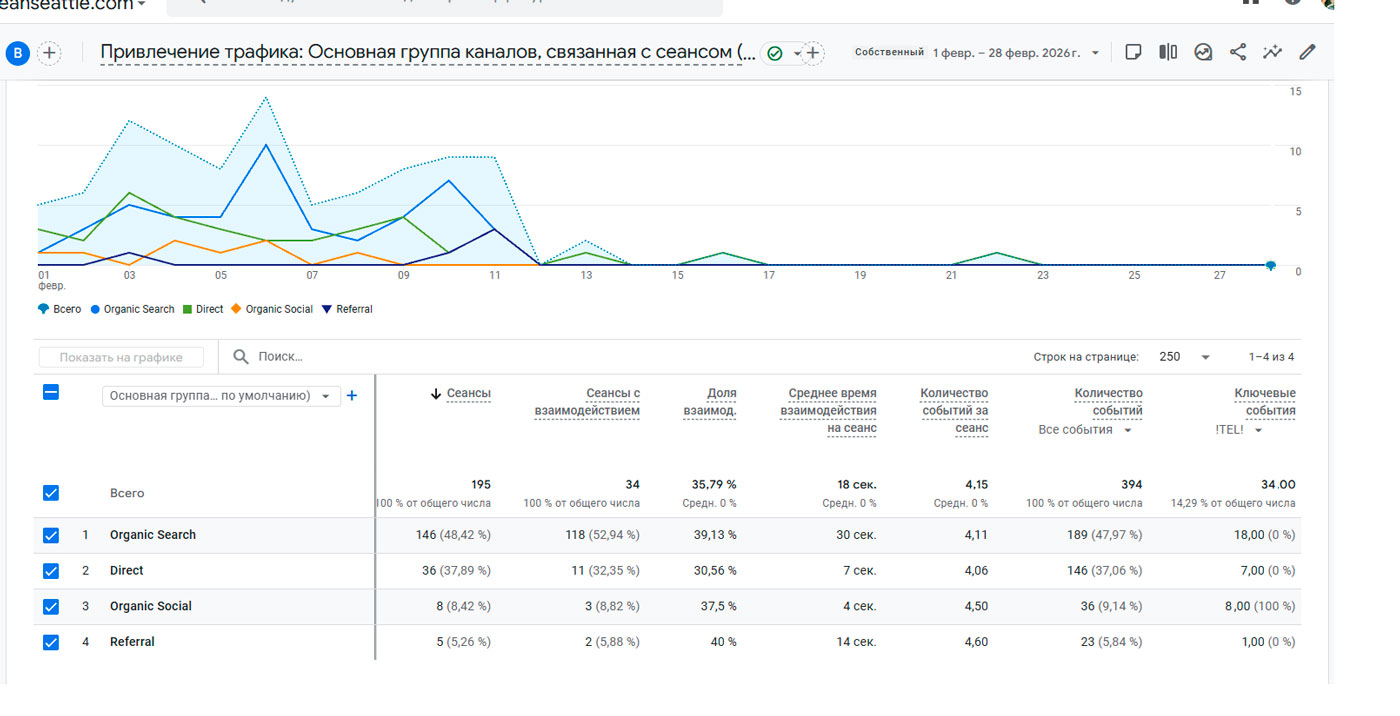
So, 34 calls and 11 forms. 45 leads in Seattle for cleaning.
What Worked — Conclusions
The promotion process we used was apparently working. In the course of our work, we ran into problems and solved them as we discovered them one by one. In the end, everything worked — the website started generating leads. All of this was driven by organic and AI traffic. All conversions were organic, one way or another. The GBP location contributed almost nothing: fewer than 10 click-throughs to the website over 2 months. There were no calls and no direct conversions. Let’s summarize the process:
- website with a flat structure
- promoted the homepage and the location page for the city of Bellevue with the primary service
- heavy focus on geo-relevance of pages — everything optimized around toponyms
- a large number of NAP citations on the website pages — internal linking to the homepage
- blog — internal linking to the homepage using a varied list of anchors (commercial — primary service, diluted commercial, branded, naked URL)
- dropped manta and switched to NAP updates via BrightLocal. This worked — at least, traffic appeared on the website after that move
- GBP posting — standard — once a week
- social media accounts connected and actively posted to
That small list described a large volume of our work. It is a shame that we were unable to continue working with this client — this project had the potential to grow into something far greater than what it ultimately became. So, a piece of advice for both business owners and SEO specialists:
Conclusion
This case study is a clear example of the fact that promoting cleaning services can be done successfully in virtually any city in the USA. Even in one as highly competitive as Seattle.
The key to success: patience, systematic work, and optimism!