
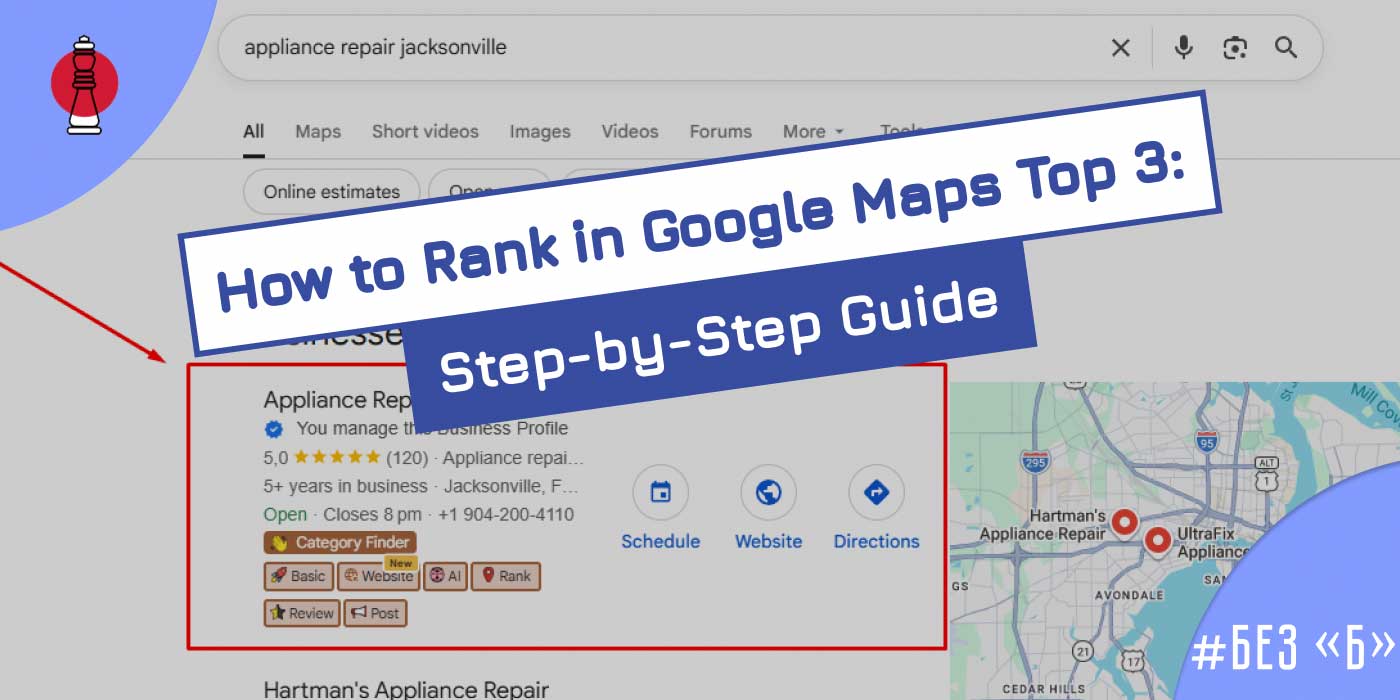
All owners of local businesses, without exception, dream that their GBP location will appear as high as possible in Google Maps. At the same time, there are many different myths, versions, and misconceptions about what needs to be done for this. The goal of this article: to get to the bottom of the issue and formulate the factors and the order of actions that will bring your business to the intended goal. So, how do you get into the Google Maps TOP-3? Detailed and substantiated below.
What Is the Google Maps TOP and Why It Matters
We need to clearly understand: where inquiries from potential clients can come to our website or to our phone. I propose to set aside advertising placements from our reasoning and focus only on free leads. So, we have a search results page (or SERP) for a certain query. What’s on it:
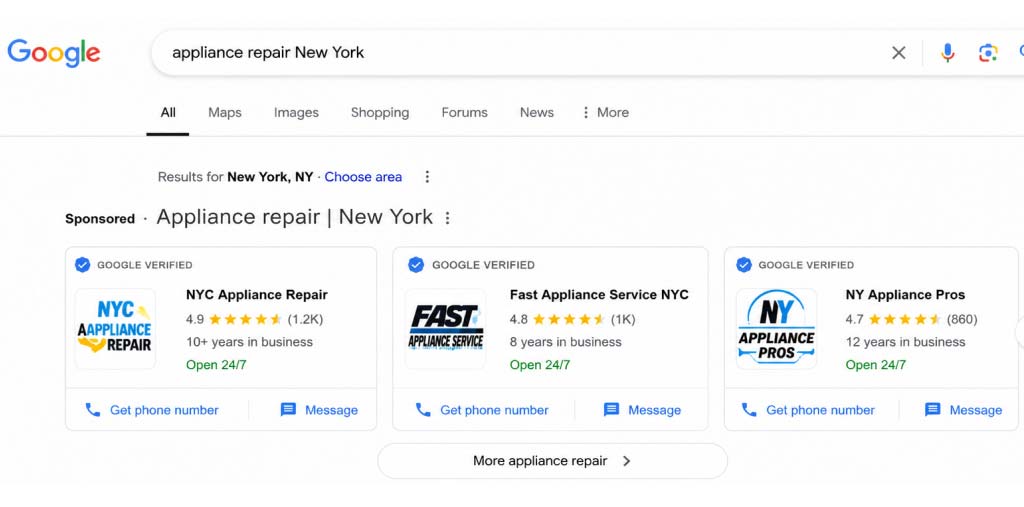
1. The top block is the LSA (Local Services Ads) ad block. We don’t take it into account, but we understand that it exists.
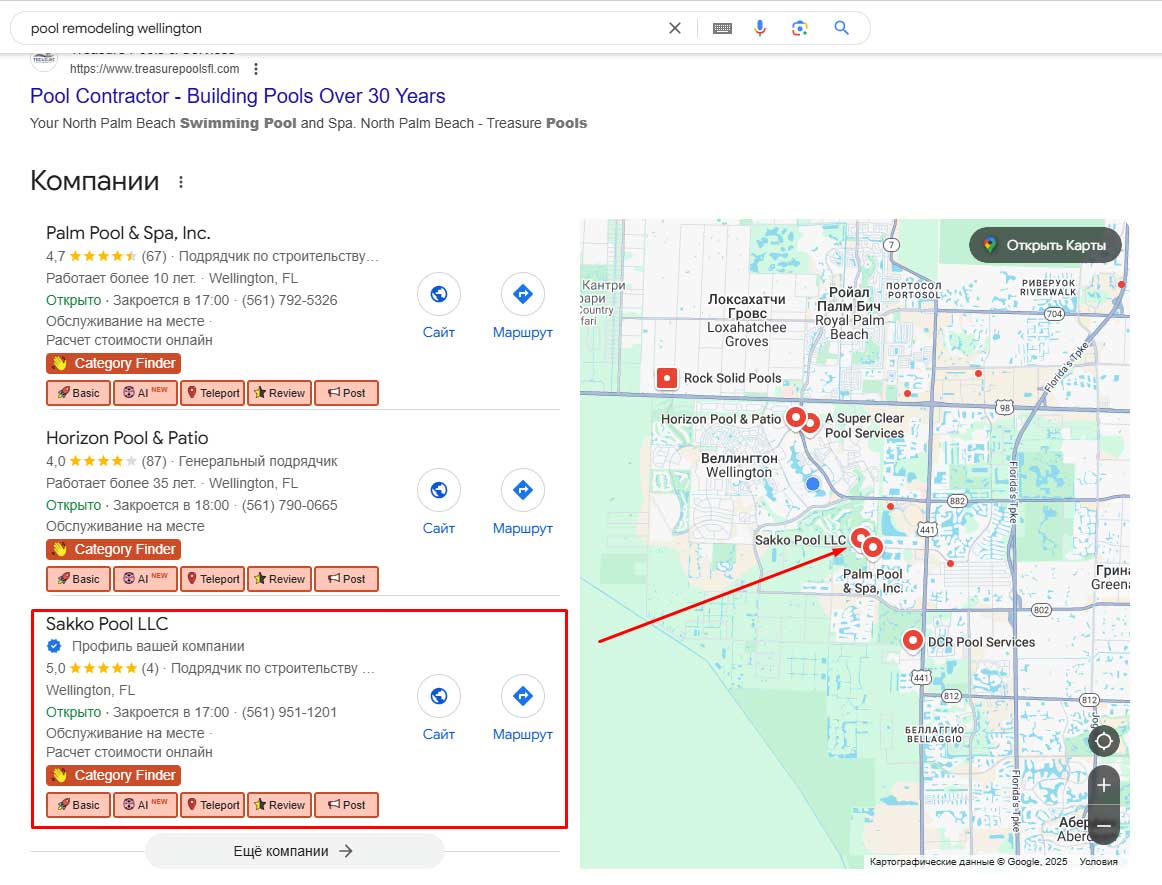
2. The next block is the local pack from Google Maps. This is exactly what we must note and fix. It contains from one to five companies, depending on the place, query, competition, and category.
3. Below is the local organic results block. This is also important and we also note and fix it. This is where websites of local companies are ranked.
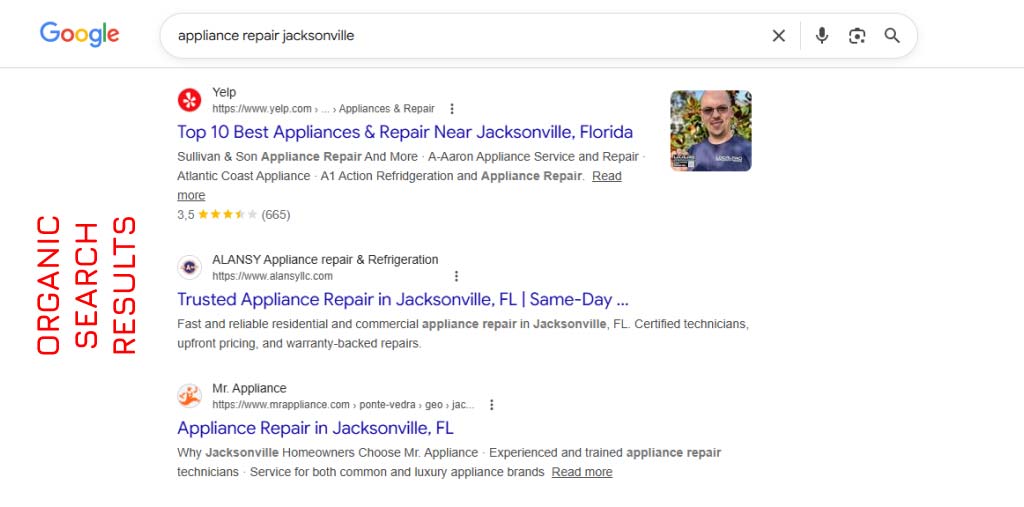
What we must note and fix: if our company has a location in Google Maps and a website linked to it, then we can receive inquiries (leads) either from the local pack (this is the work of our location), or from the local organic results — this is the work of the website.
And now an important circumstance: Google didn’t place the local pack block (or the block from Google Maps) above organic search results for nothing. By doing so, it gave priority to the GBP location for local companies over the website. At the same time, note that often the TOP of the organic results is filled with aggregators or very large franchise companies. And the local pack, more often than not, is filled with fairly modest firms that develop their own website and profile. So, we note:
Backlinko (Brian Dean) provides us with the following numbers (research based on 4,000,000 search results), primary source https://backlinko.com/google-ctr-stats:
42% of users conducting local searches click on results displayed in the Google Maps block
Who are we to question Brian’s research, so we’ll accept these numbers. And this allows us to draw the following conclusion:
This is the main answer to the question: why it’s important to get specifically into the Google Maps TOP-3. Simply because all companies located below the TOP will be competing for a negligible share of demand. Or the same can be formulated in other words: your company does not exist if it is not in the three-pack (TOP-3) of Google Maps.
And here’s the confirmation of my words with numbers: SOCi conducted a study on 12.9 billion data points. In their opinion:
Companies that made it into Google’s “three-pack” receive 126% more traffic and 93% more actions (calls, website clicks, and direction requests) than companies occupying positions 4 through 10
Step-by-Step Plan
So, my step-by-step plan is as follows:
- Website — this is the foundation. Without it, it will be difficult for us to count on a TOP-3 location in a large coverage area.
- GBP profile — this is a superstructure over the website. Without it, it will be very difficult for the location to obtain positions, just as it will be for the website without the location. Mutual dependency! A connection is needed!
- Reviews — this is the car’s fuel on the road to success. Without them, it’s impossible to promote a location and difficult to promote a website.
- Links and citations — this is the amplification of the actions of the first three points. A promotion catalyst.
- Content and activity — maintaining activity and a constant signal to the system about the relevance of the company.
As we can see, there are not many points, only five. Now about each in order.
Step 1 — Website
It would seem that the previous block substantiated the importance and “coolness” of the location, its important role for a local company. However, everything is much more complex.
Why Develop a Website
Yes, indeed, a GBP location with good visibility is capable of significantly influencing the flow of free leads for your company. But, as we know from the article: What You Need to Know for Promotion in Google Maps, which I recommend studying, one of the main factors in the ranking of a location is the proximity of the company to the person conducting the search.
That is, it is possible to cover a very large area in the TOP of Maps, but this is still a measurable value, and analysis systems such as BrightLocal use a maximum coverage radius of 25 miles from the centroid (roughly speaking, the company’s place on the map). And by this, in essence, Google limits your company by the level of demand (the market).
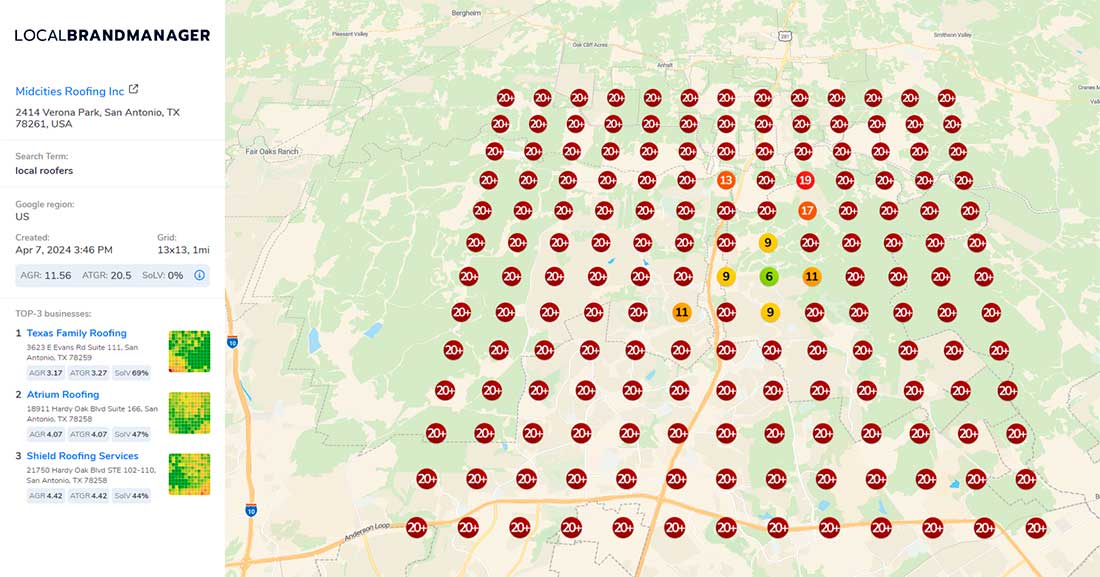
Large cities, however, have a significantly larger radius. And this is the circumstance when a location can “hit” the ceiling of its capabilities. But a website optimized for a specific location and having achieved the TOP in a specific city — this is exactly the growth point I recommend using. This is the first circumstance we must fix.
Second: it is very naive to believe that the user’s path, after they saw your company in the TOP-3 of Maps, is associated with instant conversion. Everything is not so. According to my observations, about 50% of users who went to the location profile — go to the website. And this means that whether there will be a lead or not (the person will just leave) will depend on: how well the page can convert. From my own experience, I had projects where traffic from Maps converted ~90% from website pages. There were also websites that converted no more than 20%. Now imagine that a location generated traffic in a month: a modest 100 users (3.3 people per day) to the website. In one case — that’s 90 leads. In the other — no more than 20. Feel the difference.
And third: try to analyze the locations of companies that have TOP-3 in Google Maps with a large coverage area, for example, those that make it into the TOP in million-population cities. I recommend paying attention to their websites. You may be surprised, but all such firms will have very well-developed and optimized web solutions. Why is this so? The answer is simple: You will not rank a location with a relatively large coverage area high without the involvement of a website. Moreover, Google even has a recommendation: what elements a website must contain for its growth, as well as for the growth of the location linked to it. I again refer respected readers to my article: Promotion in Google Maps, which examines more than 160 factors influencing the local ranking of a company.
Let’s summarize:
Optimization Nuances
In this block, I will not provide justification for why exactly these factors are important, so as not to overload the article and not go off track. Those wishing to understand this, I refer to the already mentioned article. Here, we will note briefly:
- Landing page — the one that looks at the location, must be optimized for the main key. Here I give two main recommendations: the main key must be a toponym with your region, for example appliance repair Toronto; and the landing page for small companies should be the main page of the website.
- Structure — a very important element for a successful website. Let’s note the following: for a local company, there must be a Services section in the main menu. I recommend duplicating it as a separate block on the landing page.
- Service pages — this is a common mistake of owners who are not SEO specialists. Stuffing as many of their services as possible into services. But the truth is that this shouldn’t be done. Unjustified service pages can cannibalize the landing page or other pages of the website. For example, for cleaning, a Deep Cleaning service on a separate page prevents the main landing page optimized for Cleaning Services from growing. Take this into account, work through the structure with justification. Don’t copy the mistakes of competitors. Use a silo structure, if possible, form thematic hubs.
- Blog — for local promotion, not an important section. There is no need to link to it from the main menu. This link is site-wide, strong, and by this you throw off the system, shifting focus to informational queries from commercial ones. But you need a client, right?
- Semantics and content — commercial queries should not be mixed with informational ones. And hence the second recommendation — don’t inflate commercial pages with unnecessary information. All recommendations, tips, and how-to’s — we send to the Blog. Write articles on them.
- Interlinking — a very important element of optimization. Don’t link everything to everything. Stick to the silo structure.
- Location pages — often can be useful, but don’t make hundreds of them. 5–10 pages of cities that are near your location will certainly not be superfluous, but no more.
- NAP — name, address, phone on the website and on the location must match 100%. I would also add operating hours here. This is the basic information about the company that in all places of citation must be 100% identical!
- Social media — if they exist and are maintained, then be sure to link to your pages on social media from the footer. I want to draw attention to the fact that TOP companies definitely maintain their pages on social media. Why not do the same?
- Microdata markup — a very important element and a significant factor in optimization. Use all possibilities: from services, geolocation, ratings, reviews — to specific markups, for example, awards or badges from trusted resources, catalogs, ratings.
Without a doubt, this list could be continued. But even the correct use of these ten recommendations will bring you closer to TOP-3 in Google Maps.
Step 2 — Google Business Profile
Setting up and optimizing a company profile in Maps is quite trivial. Let’s focus on recommendations and main mistakes:
- Name — watch for strict NAP consistency. Moreover, I’ll extend this point: phone, address, operating hours must correspond to the NAP on the website.
- Primary category — previously it was easy to make a bold mistake with it, but now Google formally itself accurately positions the location by assigning it a primary category during its registration. But you need to monitor and verify.
- Additional categories — have become less significant than they used to be. Now this, in my opinion, is a rudiment that may soon disappear.
- Link to the landing page — this is the most important thing you must correctly indicate and check 100 times. The link should not point to a social media page, a booking page, or the like. It should lead the user to the landing page of the website.
- Completeness of profile filling — is important and it’s worth doing. Taking into account the logo, exterior and interior views, and other thematic photographs that characterize your business.
- Locations without an address or SAB — for a small business, this is a non-promotable resource. Or put it this way: having a confirmed address on a GBP location for getting free leads is absolutely necessary!
In fact, if during registration you indicated everything correctly, verified the location, added photos, checked the website link — this is already enough for these settings to give the opportunity to become a promotable unit. Everything is trivial here.
Step 3 — Reviews
This is truly the fuel for local growth into TOP-3 of Google Maps. If you have a young company and you want to get free leads provided that steps 1 and 2 are completed — collect 10 reviews from your clients and you will see how quickly the system reacts to this in the form of the first free leads. And to collect them faster and not make mistakes — study the article TOP-5 Legal Ways to Get Reviews in Google Maps.
For the growth of any company in Maps, review-getting dynamics is needed. These should not be “spikes,” for example 20 reviews and then 2 months of silence. No! You must systematically and regularly send the system a signal that the client is completely satisfied with your work.
What is the pace? In my opinion, virtually any business will find ~15 reviews per month sufficient to improve rankings. For more noticeable growth — 30 reviews per month. That said, a pace of 30 was enough for me to take companies to the TOP-1 of Google Maps in million-population cities in America with a coverage area of the entire city!
Step 4 — Links and Citations
A lot of debate has been had about the influence of links and building a link profile. I know projects where the locations have no address, that is, locations in the form of SAB (Service Area Business), but they hold a multi-million city in TOP-1. And this is solely due to links. But I have projects in my work, quite a lot of them in fact, for the promotion of which I do not use link building or links at all. I don’t use it at all, I don’t work with it. And yet the websites and locations are in TOP-1 in million-population cities.
What’s important to understand: links and citations are good. But you need to allocate a budget for them. For most companies this is unacceptable — there’s simply no money. But if, instead of links, there is a desire to work and stick to a strategy, and there is also the ability to compensate for their absence with something else — this can give a good result. But together with citations it will 100% be better.
What are the requirements for links for local business? Google gives preference to local regional citations. If you provide services in Chicago — you should be cited by local resources; it’s great if these are schools, local churches, colleges, laundromats, pizzerias, restaurants, cafes. Especially if these establishments are located near you.
Don’t chase high authority indicators if you are offered to place your article on an authoritative resource. Remember that the measure of authority is just a number reflecting the authority of the resource according to someone’s opinion. And certainly not according to Google’s opinion. Citations from sites with high DR are not always useful. Often — it’s money spent for nothing, or almost for nothing.
Step 5 — Content and Activity
Just a few years ago, activity in the GBP profile was necessary for the TOP. Now — this is completely not the case. In my work I use activity, the frequency of which can be described as one post per week when promoting a fresh business. This frequency can be reduced. What’s important is not this. The impact of posting on profile ranking is extremely low at the moment.
But, if we imagine that we are promoting a website using a content method and we release one new article per week or every few weeks, then it would be silly not to use this occasion for posting. Otherwise — this will not have significant importance.
But for website promotion, especially if the chosen method is content-based — this is important. Recommendation — one page per week.
Typical Mistakes — What Definitely Should Not Be Done
Of course, there are many “pitfalls” on the way to TOP-3 in Google Maps. From experience, I will highlight the typical mistakes that, in my opinion, can seriously harm your business and that are quite often encountered in practice.
- A non-promotable website. This is the case when the website is built ineptly, illiterately, without structure, without considering the topic, region, semantics. Landing pages (single-pagers) can also be attributed here. This is an immediate fail — there is nothing to promote, nothing to grow.
- A location without an address or SAB (Service Area Business). Whatever Google may claim, its ranking mechanism in Maps is built in such a way that it simply does not allow bringing a SAB into TOP-3 of the Maps results without significant financial expenses. I have encountered such locations in practice, but they are all old, all linked to old domains with a huge number of backlinks. Their websites are trusted and very authoritative. For young companies, this is a barrier and a serious problem in promotion. This will be almost impossible to promote.
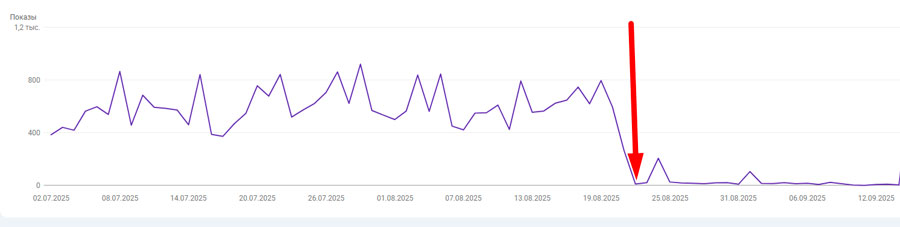
- Fake reviews. After the winter update of the local pack in 2026, very many profiles lost a fairly large portion of their reviews. Google applied a spam filter to them. Currently, it is technically almost impossible to fake reviews on a location. Moreover, according to my observations, Google has started to understand that this is irrelevant feedback and simply does not take it into account in ranking the location in Maps. In addition, there is a high probability of getting the location itself suspended and having to go through re-verification of the location. Faking reviews is a dangerous undertaking that can lead to the suspension of the company’s operations. Do not do this.
- Errors in the target page URL. This is a fixable mistake, but it can significantly affect conversion and the number of leads in promotion. Always check the URL of the target page, especially if you are using utm tags.
- Irrelevant NAP data. This is a very common and unpleasant problem, related to the fact that the NAP data on the website and on the location do not match. And it is unpleasant because some catalogs, one way or another, will create records in their databases and they will also be erroneous. Fixing NAP between the website and the location can be done quite quickly, but pulling off the same trick with catalogs quickly won’t work. This will require time.
- Cheap links. Never buy links to your website. First, this is prohibited, second, there is minimal benefit from this if you are not a specialist in this matter, third, from cheap links the website will not just fail to win — it will significantly lose. I have had such projects in practice — this problem is always unpleasant to solve. And costly. For local business this is not needed. You can get TOP-3 in Maps even without this, without spending a single cent on links.
How Long Does It Take to Get Into the TOP of Maps
This is the most frequent question I hear from my clients. It’s impossible to answer it definitively. Because the promotion process consists not only of work on optimizing the website and profile (and this really is under the control of the SEO specialist — this can be predicted with a sufficient degree of probability for a given topic in a given region), but also of processes that are not related to SEO work but relate to the work of the business, for example, the number of reviews received per month. In 2026 I would put it this way:
But if we assume that a good service is being promoted, one that is capable of generating from 15 reviews per month and doing everything within the framework of the planned strategy systematically, then in my practice the fastest exit to the TOP is 2 months.
Usually, in order to significantly increase the number of free leads, you need from 2 to 3 months of promotion (given a quality website, a promotable location, reviews).
To become a TOP in a million-population city, systematic routine work is required, provided that both the SEO company and the business are working. In my practice, this result was achieved on average from 4 to 12 months, depending on the geo and the topic (I’ll immediately note that the website and location must be well-promotable; the location must have the ability to grow quickly). Number of inquiries per day — from 20. On average — this is ~ 650-700 leads per month for a million-population city with almost complete coverage of the city in TOP-3 Google Maps.
However, it should also be taken into account that not everywhere young companies can become TOP. This is related, first of all, to two significant barriers:
- Very high competition in the city among trusted companies.
- An unfavorable location of the point in GBP (address), which leads to the inability of it to grow.
Conclusion
If you provide an excellent service, your service is TOP, but you are experiencing a shortage of free leads, then having an optimized website, a location, and a configured process of getting reviews is capable of providing you, within a completely realistically foreseeable period, with a regular flow of inquiries through the TOP of Google Maps. The priority is as follows:
- Website — the foundation.
- Location — the walls.
- Reviews — the fuel.
- Content — expansion of semantics, retention of positions.
- Citations — the boost.
I wish you success and am glad to be helpful! See you soon on the air!
FAQ

My specialty is promoting service-based websites. I have solid expertise and a strong portfolio of SEO and Google Maps (local SEO) case studies across a wide range of industries, primarily in Home Services. Here, I share my case studies and insights. I’d really appreciate your comments and feedback!